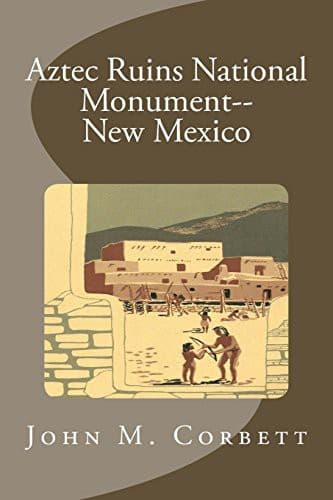
Aztec Ruins National Monument, New MexicoCorbett, John M. (John Maxwell)
History
Aztec Ruins National Monument, New Mexico
Corbett, John M. (John Maxwell)
Aztec Ruins National Monument (N.M.)
The principal structures are large pueblos handsomely built of stone,
and in a pretty good state of preservation. The external walls are
composed of yellow Cretaceous sandstone, dressed to a common smooth
surface without hammer-marks; in some places they are still 25 feet in
height. As usual in buildings of this kind, the walls were unbroken by
door or window to a height of 15 feet above the foundation. The
interior shows a great number of small rooms, many of which are in a
perfect state or preservation, and handsomely plastered. These
structures are surrounded by mounds and fragments of masonry, marking
the sites of great numbers of subordinate buildings; the whole
affording conclusive evidence that a large population once had its
home here.
[Illustration: Aztec Ruins in 1895.]
[Illustration: AZTEC RUINS—GROUND PLAN]
White settlement of the valley around the ruins area began in 1876, and
from that time on the ruins have been well known.
The first scientific investigations of the ruins were made in 1878, when
Lewis H. Morgan visited the site and later published a description with
a good ground plan. Morgan, sometimes known as “the father of American
anthropology,” was one of the most distinguished scientists of the 19th
century. He is well known for his ethnological studies of the Iroquois
Indians in New York. Though usually thought of as a “social
anthropologist,” Morgan had a great and abiding interest in archeology,
particularly that of the southwestern part of what is now the United
States, Mexico, and Central America. On his trip to the Southwest in
1878, he kept a journal full of observations and notes about the various
ruins which he visited.
In those days the railroad extended only to Canyon City, Colo., and from
there Morgan and his party had to proceed by wagon. One of the ruins
which especially seemed to intrigue Morgan was the one on the Animas
River, which we now call Aztec. He not only made a ground plan of the
entire ruin, but noted that there were other structures of considerable
size and interest in the immediate vicinity. He also entered some of the
rooms, particularly in the west wing of the larger ruin, which still had
their ceilings intact. Even at that time, evidently a good bit of the
ruin had already been destroyed by the early settlers, for Morgan
records the fact that one man at Animas City, who had lived near the
ruins, told him that about one quarter of the stones had been taken away
by the settlers to use in building houses, lining wells, or for other
construction purposes. Morgan also talks about entering rooms on the
second story, so presumably some of these upper stories may still have
been intact in 1878.
Public-domain text, read in full here on John Shaqi.
Reviews
Reviews
No reviews yet
Be the first to share your thoughts on this work.
Join the Discussion
Join the discussion
Sign in to leave a comment or review.
Sign InorCreate an account