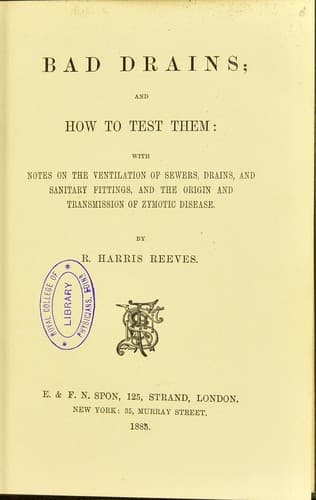
Bad Drains; and How to Test Them: With notes on the ventilation of sewers, drains, and sanitary fittings, and the origin and transmission of zymotic diseaseReeves, R. Harris
Science
Bad Drains; and How to Test Them: With notes on the ventilation of sewers, drains, and sanitary fittings, and the origin and transmission of zymotic disease
Reeves, R. Harris
Sewerage
CONTENTS.
PAGE
BAD DRAINS, AND HOW TO TEST THEM 1
SEWER VENTILATION 32
THE ORIGIN AND TRANSMISSION OF ZYMOTIC DISEASE 56
BAD DRAINS;
AND
HOW TO TEST THEM.
“Bad Drains.” How often has this term been used during the last few
years? By the medical profession alone, thousands of cases have been
attributed to this cause. To the honour and credit of that profession
its members have thought out and worked out the cause of innumerable
cases of disease under their charge, and rightly fixed their origin to
be due to “bad drains.”
In many cases it has been but a fashionable term to describe cases which
had the appearance of gas poisoning, but did not owe their origin to
drains; but rather to the heated and impure atmosphere of rooms, late
hours, and the sudden change from heat to cold. If there have been a few
hundred cases where “bad drains” were supposed to have caused the
illness and such was not the case, there have been thousands of others
where the disease originated from them, but was taken as a matter of
course, or as one of the frailties of the human frame, when undoubtedly
the cause was “bad drains.”
It is a most remarkable thing, that whilst on the one hand we have the
medical profession energetically working to find out defects in the
planning of drains and sanitary fittings, and writing articles on them,
we have on the other hand surveyors and others who have treated the
matter as a doctor’s fad.
During the last five years scarcely a medical conference has been held
without the question of “bad drains” forming one of the principal
subjects discussed. Medical officers of health have made stirring
speeches and reports to Local Boards; but where is the surveyor who has
had the energy to do the same unless it has been actually forced upon
him? It is a curious but noteworthy fact, that nearly the whole of the
evils of badly constructed drains, and the principal improvements in
them, have been forced on surveyors, builders, and plumbers by the
medical profession and the public.
The reticence shown by surveyors in dealing with “bad drains” may be
attributed to their unwillingness to acknowledge the errors and defects
in works already executed. These works were, at the time, executed
according to the theories adopted by the most eminent engineers in the
profession, and it would be considered unprofessional to admit errors.
There is scarcely a district (excepting where drains have been laid
within the last three years) where the branch drains are trapped into
the main sewers with an efficient water-seal. Surveyors feel that to
acknowledge this would be tantamount to acknowledging a want of
professional knowledge or neglect of duty on their part.
Public-domain text, read in full here on John Shaqi.
Reviews
Reviews
No reviews yet
Be the first to share your thoughts on this work.
Join the Discussion
Join the discussion
Sign in to leave a comment or review.
Sign InorCreate an account