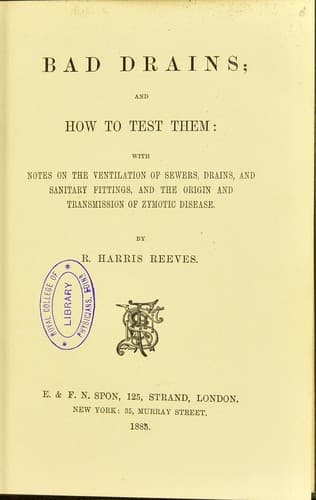
Bad Drains; and How to Test Them: With notes on the ventilation of sewers, drains, and sanitary fittings, and the origin and transmission of zymotic disease — John Shaqi
Bad Drains; and How to Test Them: With notes on the ventilation of sewers, drains, and sanitary fittings, and the origin and transmission of zymotic diseaseReeves, R. Harris
Science
Bad Drains; and How to Test Them: With notes on the ventilation of sewers, drains, and sanitary fittings, and the origin and transmission of zymotic disease
Reeves, R. Harris
Sewerage
In cesspits and old drains the soil and putrid matter have been for
years allowed to accumulate, and the poison from such matter, when
distributed into the open air through gratings in the new sewers or into
houses, is, when inhaled into the system, the cause of these zymotic
outbreaks. In tracing these old drains and in preventing stagnant gases
from remaining in any portion of the drain, the engineer or architect
cannot pay too much attention, as confined gases when charged with
poisons from putrid matter are the principal factors in producing
disease.
Many persons place a well-constructed trap at the inlet, and another
some distance along the drain, say at the end of a building or grounds,
without any ventilation between the two traps. In fact this used to be a
common occurrence; but it should never be done. If the drain should be a
6-inch one, and the traps 50 feet apart, the amount of gas between the
two traps would average 9 cubic feet, and this gas would in the ordinary
working of the drain remain for years, getting more poisonous the longer
it remained undisturbed. The owner of the house, knowing that he had a
good trapped drain connected to sewers, would feel himself safe, and
naturally think his house healthy. Far better for him if the house were
drained into a ventilated cesspit, as when the gases in the drain became
released, which may occur by the siphoning of the traps at the
house-connection, the danger would be equal to the emptying of a disused
cesspit, and carrying the contents through the house. The more a person
tests the working of gas in sewers or drains the more he will find that
branch drains from their construction supply the poisons which render
the gases in the sewers themselves so noxious.
In 1880, whilst engaged in tracing the course of an outbreak of typhoid,
I made a series of experiments with a view to trace the source from
which the disease emanated, and every experiment proved that the origin
of the disease lay in the gases which were in contact with putrid sewage
matter, existing in old drains and cesspits attached to the sewers as
well as in the gases which were confined between traps. The distribution
of the disease was due to the imperfect construction of the sewers,
drains, and sanitary fittings.
The most successful experiment, and the one from which the greatest
result was obtained, and which I have ever since most successfully used,
was in determining the state, size, and condition of the drains
underground, and also that of the house or buildings, by measuring by
compression the gas contained in the sewer or sanitary fittings. The
principal cause of its distribution was the compression of the gas
between the water-traps, the siphoning of house-traps leaving at times a
free passage for the gas to enter the house.
Public-domain text, read in full here on John Shaqi.
Reviews
Reviews
No reviews yet
Be the first to share your thoughts on this work.
Join the Discussion
Join the discussion
Sign in to leave a comment or review.
Sign InorCreate an account