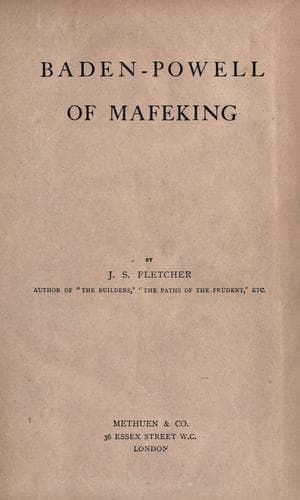
Baden-Powell of MafekingFletcher, J. S. (Joseph Smith)
History
Baden-Powell of Mafeking
Fletcher, J. S. (Joseph Smith)
Baden-Powell of Gilwell, Robert Stephenson Smyth Baden-Powell, Baron, 1857-1941; Generals -- Great Britain -- Biography
An instance of Baden-Powell's careful attention to small details is
given in the same chapter of "Aids to Scouting." "I was once acting as
scout for a party in a desert country," he says, "where we were getting
done up for want of water. I had gone out two or three miles ahead to
where I thought the ground seemed to slope slightly downwards, but
except a very shallow, dry water-course, there was no sign of water.
As I was making my way slowly back again, I noticed a scratching in
the sand, evidently recently made by a buck, and the sand thrown up
was of a darker colour, therefore damper, than that on the surface. I
dismounted and scooped up more with my hands, and found the under-soil
quite moist, so water was evidently near, and could probably be got
by digging. But at that moment two pigeons sprang up and flew away
from under a rock near by; full of hope, I went to the spot and found
there a small pool of water, which yielded sufficient for the immediate
requirements of the party. Had I not noticed the buck-scratching, or
the pigeons flying up, we should have had a painful toil of many miles
before we struck on the river, which we eventually did come to."
There are abundant evidences in "Aids to Scouting" of the extraordinary
patience which its author possesses, and of the way in which he has
exercised it in perfecting himself as a scout. He mentions, as if it
were a mere nothing, that he once took up a position amongst some rocks
overhanging a path, and so close to it that he could have touched
passers-by with a fishing-rod, and remained there for two hours in
order to see how many people who passed him would perceive him. He took
no pains to conceal himself, but merely sat down, a little above the
level of a man's eye. During the two hours fifty-four persons passed
him, and he was only noticed by eleven of them. But how many of us are
there who have the patience to remain motionless for two hours?--all
for the sake of an experiment! But Baden-Powell's patience gains a
great deal in its value to him as a scout by its being linked with
a marvellous power of deduction. He likes to find out everything he
can about all that he sees, keeps a sharp eye on the people he meets,
tries to deduce what they are from their personal appearance, outward
signs, and chance observations, and is all the better satisfied if
he finds that his conclusions are true. When he was in India he used
to go out in the early mornings looking for what he could find and
deducing arguments from signs and things thus found. He gives numerous
illustrations of this exercise of his logical faculties in "Aids to
Scouting," of which the following is a typical example:--
EXAMPLE OF DEDUCTION FROM SIGNS. ("Aids to Scouting," p. 75.)
_Locality._--A mountain path in Kashmir.
_Weather._--Dry and fine. There had been heavy rain two days before,
but the ground had dried the same night.
Public-domain text, read in full here on John Shaqi.
Reviews
Reviews
No reviews yet
Be the first to share your thoughts on this work.
Join the Discussion
Join the discussion
Sign in to leave a comment or review.
Sign InorCreate an account