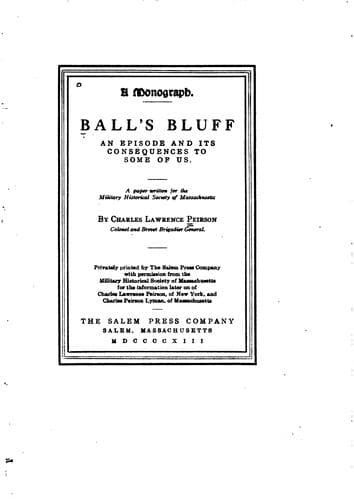
Ball's Bluff: An Episode and Its Consequences to Some of UsPeirson, Charles Lawrence
History
Ball's Bluff: An Episode and Its Consequences to Some of Us
Peirson, Charles Lawrence
Ball's Bluff, Battle of, Va., 1861; Libby Prison
General McClellan, who was in command when we joined the Army of the
Potomac, was a thoroughly educated soldier. Soon after his graduation
from West Point, he was employed in the construction of the first
Pacific Railway. Later he was selected as one of a Commission to study
the Art of War in Europe. For a time he was with the Allied Armies in
the Crimean War, with every possibility of instructing himself in siege
operations, construction of military bridges and use of pontoons, and
the accepted order of battle for the different arms of the service.
Always occupied with matters of large importance, and with all these
military experiences, he became the best equipped man for the command
of the Union Army. General McClellan was the most popular Commander
that the Army ever had. The men thoroughly believed in him. Certainly
the country owed much to him for the thorough organization of the Army,
which enabled less qualified Commanders, (before the time of Meade and
Grant), to accomplish something with it.
The Twentieth Massachusetts Regiment was attached to General Stone's
Corps of Observation, and was encamped near Edward's Ferry on the
Potomac River, some three miles from Ball's Bluff. General Stone was an
accomplished soldier and we all respected him as such.
We were part of the Brigade of General F. W. Lander. I had known him
well in Salem, where our families resided. He had had a most
adventurous life as an explorer, having once crossed the continent from
San Francisco to the East, alone, his companion having died on the
journey. His courage was unquestioned, and he had military ability.
General Evans, who was the Confederate Commander of the enemy's forces
near Leesburg, expected General Stone to attack him from Edward's
Ferry, and was slow in moving troops to the vicinity of Ball's Bluff in
consequence. On October 20th, General McClellan received information
that the enemy had withdrawn from their advanced post at Leesburg, and
so advised General Stone, suggesting a demonstration to confirm this
fact, or to accomplish it.
Public-domain text, read in full here on John Shaqi.
Reviews
Reviews
No reviews yet
Be the first to share your thoughts on this work.
Join the Discussion
Join the discussion
Sign in to leave a comment or review.
Sign InorCreate an account