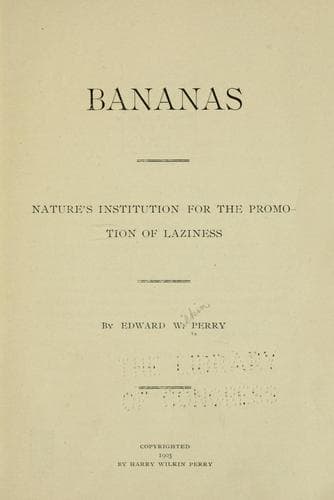
Bananas: Nature's Institution for the Promotion of LazinessPerry, Edward Wilkin
Science
Bananas: Nature's Institution for the Promotion of Laziness
Perry, Edward Wilkin
Bananas
The plantain is so abundant and cheap that it might, if cut and dried
in its green state, be exported with advantage. It is in this unripe
state that it is so largely used by the peasantry of this Colony as
an article of food. When dried and reduced to the state of meal, it
cannot like wheat flour, be manufactured into macaroni or vermicelli,
or, at least, the macaroni made from it falls into powder when put
into hot water. Plantain meal is prepared by stripping off the husk
of the plantain, slicing the core, and drying it in the sun. When
thoroughly dry it is powdered and sifted. It has a fragrant odor,
acquired in drying, somewhat resembling fresh hay or tea. It is
largely employed as the food of infants and invalids. In respect to
nutritiveness it deserves a preference over all the pure starches on
account of the proteine compounds it contains. The flavor of the meal
depends a good deal on the rapidity with which the slices are dried.
Above all, the plantain must not be allowed to approach too closely
to yellowness or ripeness, otherwise it becomes impossible to dry it.
The color of the meal is injured when steel knives are used in husking
or slicing, but silver or nickel blades do not injure the color.
Full-sized and well-filled bunches give 60 per cent. of core to 40
per cent. of husk and top-stem; but in general it would be found that
the core did not much exceed 50 per cent. of dry meal, so that from
20 to 25 per cent. of meal is obtained from the plantain, or 5 pounds
from the average bunch of 25 pounds; and an acre of plantain walk of
average quality, producing during the year 450 such bunches, would
yield 4 tons and 10 pounds of meal.
In 1891, C. W. Meaden wrote from Trinidad to the following effect in
relation to a trial shipment of dried bananas:
This experiment will prove of importance to banana growers, as drying
bananas seems to open a way no other means offers of utilizing fruit.
It overcomes the difficulty of bad roads, long hauls and other
drawbacks some planters have to face in marketing bananas.
The result of drying six bunches, weighing an average of 52 pounds
per ripe bunch, was 97 pounds of dried fruit. There was a loss of
two-thirds in peeling and drying. The fruit sold for $19.40, or 20
cents per pound. Deducting freight charges left $15.47, or a fraction
under 16 cents per pound. This was at the rate of $2.72 per bunch. The
cost was put at 53 cents, which covered purchase of land, clearing
woods and draining, planting, weeding and cutting, drying, fuel, boxes
and packing; but did not include cost of dryer, as that would be but
a fraction on each bunch dried. After deducting the above there was a
profit of $2.19 per bunch.
Mr. Meaden said of this:
Public-domain text, read in full here on John Shaqi.
Reviews
Reviews
No reviews yet
Be the first to share your thoughts on this work.
Join the Discussion
Join the discussion
Sign in to leave a comment or review.
Sign InorCreate an account