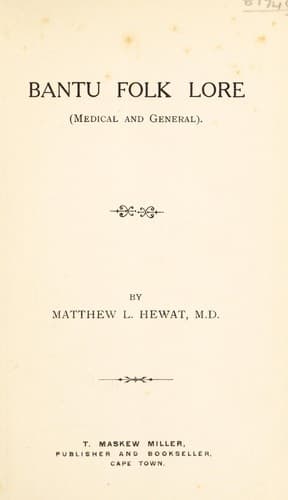
Bantu Folk Lore (Medical and General)Hewat, Matthew L.
Science
Bantu Folk Lore (Medical and General)
Hewat, Matthew L.
Pondo (African people); Traditional medicine -- South Africa; Xhosa (African people); Zulu (African people)
Igqira Elokuqapula. Amagqira Awokuqapula.
Uku-qapula, means to inoculate or to let blood.
These Kaffir specialists show a considerable surgical skill. They are
called in for all surgical complaints.
In most cases the surgeon exhibits internal as well as external
remedies, using purgatives and emetics freely to assist healing and
relieve pain.
Blood-letting, as his name implies, is frequently had resort to by the
native surgeon. Thus, I know of a case where one of these Awokuqapula
on his own initiative incised the temporal artery for persistent
neuralgia.
Blood-letting by means of incisions or scarifications is frequently
used to relieve deep seated pain. A common method of treating pleuritic
pain is to scarify over the ribs and rub in some irritant.
The native Surgeon, whether taught by outside practice or not, it is
hard to say, resorts to venesection as one of his routine methods of
treatment for violent fevers. He usually selects one of the veins of
the forearm, using direct pressure to stop the hæmorrhage when he
considers that his patient has lost enough.
A cupping instrument called “Luneka” and needles “Izinthlum” are used
by the Kaffir Surgeon for acupuncture and bleeding in such cases as
snake bite, pleurisy, etc.
Surgical cases of any degree are put in clean huts and usually on the
top of a hill, thus shewing that the Kaffir appreciates the value of
fresh, clean surroundings: and the ashes of plants (carbon) used for
wounds shows a spontaneous knowledge, that an antiseptic is of value in
assisting healing.
C. THE HERB DOCTOR (Physician).
Igqira elemiciza. Amagqira awemiciza.
(The doctor, who is of herbs.)
The herb doctor is simply a Kaffir practitioner and differs in no
essential respect from the European “herbalist,” only, he employs South
African herbs and drugs.
Some of them devote their attention to one disease or to some small
group of maladies, and by close observation and long experience, as
also by benefitting by transmitted and traditional knowledge, they
acquire fame as specialists and experts in the cure of disease; and
people send for them, or go to them from great distances, and often
reward them very liberally if they be successful.
It is not uncommon for the isanuse (witch doctor) to practice also as
an igqira elemicisa (herb doctor).
As a witch doctor he administers emetics (see later) which have no
relation to the healing art, but as a herb doctor he acts on the same
principles as the others do and may be skilful as such. He is at any
rate not more grossly inconsistent than the Roman augurs were.
D. THE RAIN DOCTOR.
Igqira elesebe. The term elesebe (who is of isebe) is derived from
“isebe” a bird, this bird being the being from which the doctor is
supposed to receive the rain.
Public-domain text, read in full here on John Shaqi.
Reviews
Reviews
No reviews yet
Be the first to share your thoughts on this work.
Join the Discussion
Join the discussion
Sign in to leave a comment or review.
Sign InorCreate an account