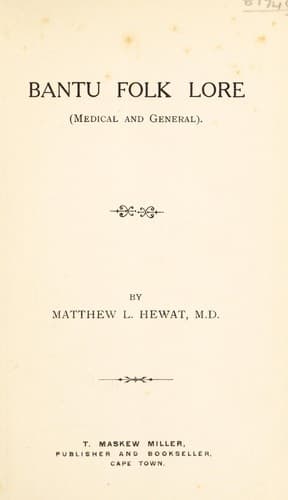
Bantu Folk Lore (Medical and General)Hewat, Matthew L.
Science
Bantu Folk Lore (Medical and General)
Hewat, Matthew L.
Pondo (African people); Traditional medicine -- South Africa; Xhosa (African people); Zulu (African people)
The general practice of Kaffir tribes is to send the sterile wife back
to her father if she prove sterile after a fair trial; and to demand
back the “lobola” i.e. her cost price.
Twins are not looked upon with favour although if they be females they
are welcomed.
In this connection, one must remember that the female is the labourer,
and when she marries, her father receives several head of cattle as
“lobola,” or purchase price of his daughter: hence their welcome.
Miscarriages are mostly attributed to witchcraft, but the sufferers
therefrom are sometimes treated medicinally.
a. The Um-kwinti (Gazania pinnata) is drunk in infusion of all its
parts.
b. The Isi-kolokoto (Sansevieria thyrsiflora) an infusion of the root
being used.
c. The In-gcelwane (Bulbine latifolia) of which a decoction of the root
and stalk is taken.
Menstruation. The first arrival of this, the average age being 14
years, is made the occasion of great ceremonies, which vary, however,
greatly in different tribes, thus:—Amongst the Sesutos, the maiden is
sent to the Native school (kept for the purpose by a woman), and turned
in what is known as a “Bale.” Much difficulty is experienced in finding
out what exactly takes place; but from what one gathers, there is no
removal of parts, as in circumcision in the male. The result of the
treatment is that the labia minora are considerably elongated,
sometimes very much so, and the female thus converted into an animal of
lust and desire. It is notorious that the Basuto women are excessively
immoral. According to them adultery is not an immoral act, unless there
has been complete possession.
Ho fuba in Sesuto (adultery) means to have complete intercourse, and if
followed by conception is punished usually by fining. A few head of
cattle or less, clearing the culprit even if she be a wife.
Papali (play), however, is an innocent flirt, and here the elongated
labia minora comes into use.
An old Basuto once said “Were it not for this custom all our woman
would repeatedly become pregnant, and thus spoil their children.”
Chiefs frequently lend their wives to their headmen, that they may
“raise children to their kraal.”
Among the Zulus and most of the other Bantu tribes the custom is
different.
The maid is confined with others in a separate hut. She has her own mat
to lie on, made of a peculiar kind of grass called “Nxopo,” her own
cooking pot and eating utensils. Only her nearest female relatives are
allowed to approach. She never touches flesh with her hands, using for
this purpose a forked stick, and she never uses milk.
(This practice of never using milk at menstrual periods is almost
universal throughout the Bantu races and most strictly adhered to. I
cannot find out any stated reason for it.)
She is not allowed to go near the father’s hut, nor to wander near the
kraals of the calves or cattle, or the other huts.
Public-domain text, read in full here on John Shaqi.
Reviews
Reviews
No reviews yet
Be the first to share your thoughts on this work.
Join the Discussion
Join the discussion
Sign in to leave a comment or review.
Sign InorCreate an account