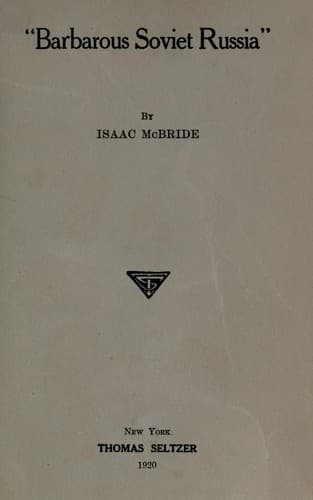
Communism -- Soviet Union; Soviet Union -- Economic conditions -- 1917-1945; Soviet Union -- Politics and government -- 1917-1936
“But it was impossible to save everything,” Gorky told me. “There were
the soldiers and the peasants, who had never had a chance to see any of
these beautiful things in the past. The people did not wish to destroy
these things. They only threw away what seemed worthless to them. One
priceless painting was found in a garbage can. But it was found and
brought back by the people themselves. And now it is in the museum where
every one may see it.”
Gorky is head of the “World Literature Publishing House,” a vast
institution organized by the Soviet Government to publish the best
literary and scientific productions of all countries in popular editions
for the Russian masses. A great staff of literary and professional men
and women are enrolled in this work. Already about six hundred books
have been edited and are ready for publication, although only thirty
volumes had been printed when the work had to stop on account of the
lack of paper. As soon as paper is available they hope to begin printing
millions of volumes in editions which will be within the reach of all
the Russian people.
In addition to this work Gorky has been devoting much time to the
preparation of a series of motion-picture scenarios, composed with
scientific historical exactness, showing the history of man from the
Stone Age down through the Middle Ages to the time of Louis XVI of
France, and finally to the present day. This work was begun in July
1919, and when I talked with Gorky in September of the same year, he
told me that they had already finished twenty-five scenarios. He
described the extraordinary difficulties under which the work was going
forward; the actors and actresses who were often undernourished,
persevered over all obstacles, inspired by an enthusiasm which Gorky
thought would have been impossible in any other country. The Soviet
Government was aiding the production in every way. The best actors and
actresses in the country had been enlisted in this work along with
historians and scientists. The films were being sent into the remote
towns and villages, and thousands of small theatres already were being
built.
The motion picture theatres in general in Petrograd were not showing the
ordinary romances that we see in this country in films. The motion
picture was used largely for educating the people and showing the
development of industry, the proper care of children and the advantages
of sanitary conditions. Russia is in great need of education so far as
sanitation is concerned. In the large cities the sanitation is modern,
but in smaller towns and in the villages the people have no idea of a
sewage system.
Public-domain text, read in full here on John Shaqi.
Reviews
Reviews
No reviews yet
Be the first to share your thoughts on this work.
Join the Discussion
Join the discussion
Sign in to leave a comment or review.
Sign InorCreate an account