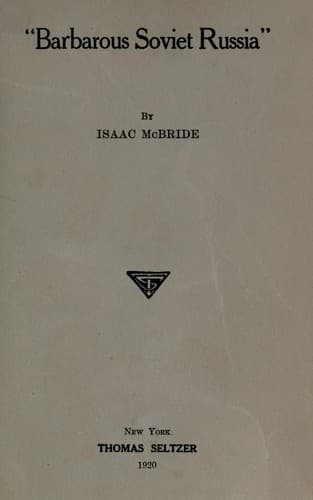
Communism -- Soviet Union; Soviet Union -- Economic conditions -- 1917-1945; Soviet Union -- Politics and government -- 1917-1936
“But you must not go to Moscow,” he added. “You will surely never return
alive—but if you do, please come and tell me what you have seen.” And
mournfully he wished me a safe journey.
I returned to the Foreign Office the next day determined to get
permission at once to pass through the Lettish front into Soviet Russia.
It was a hot August day. Officers and attachés sat around panting,
obviously bored that any one should come at this time to annoy them. Yet
despite the heat, they were willing enough to argue with me when they
learned that I wished to go into Soviet Russia. Like the young man I
talked to before, they tried hard to dissuade me. They were full of
forebodings.
“You will be robbed of the clothes on your back the minute you fall into
the hands of the Bolshevists,” they insisted.
“You must be crazy,” said one particularly friendly officer, whose
blonde hair stood straight up from his head so that he looked
perpetually frightened.
“But I am an American correspondent,” I repeated over and over again,
not knowing what else to say.
“So that is it,” said the officer, seeming to understand all at once.
And shortly after that the Foreign Office at Riga decided to recommend
the General Staff that I be permitted to pass the lines. But still they
urged me not to go.
“You will come back naked if you come back alive,” they shouted to me in
parting.
I left Riga on a troop train at six o’clock in the evening of September
1, 1919, bound for Red Russia. By noon the following day we had reached
a small town, where I disembarked with the soldiers. The front was
fifteen versts away. There the Reds had established themselves, I was
told, in old German trenches near the town of Levenhoff, 107 versts from
Riga.
I carried a heavy suitcase, an overcoat and an umbrella, and the thought
of trudging in the wake of the less heavily caparisoned soldiers was
discouraging. I accosted a smart young officer with blonde mustaches. He
listened to me with interest.
“I am an American correspondent,” I said, “accredited to your
headquarters.”
He glanced at my papers and shrugged his shoulders with such an air of
indifference that I thought he was not going to help me at all. But he
told me to follow him, and a short distance up the road we came upon a
peasant driving a crude hay-rick drawn by a single gaunt horse.
After a brief parley, none of which I understood, the peasant got down
from his high seat, hoisted my suitcase into the vehicle, and I followed
it. I sat flat on the floor with my feet braced against the sides of the
springless cart, and we started jolting and bumping down the rough road
which ran parallel with the tracks. The peasant sat on a board laid
across the front of the rick.
We had gone only a short way when the booming of guns came from both
sides of us. My driver, however, seemed unconscious of it. We went on
for another five versts. The guns grew louder and I saw shrapnel shells
burst uncomfortably near. They came thicker and faster.
Public-domain text, read in full here on John Shaqi.
Reviews
Reviews
No reviews yet
Be the first to share your thoughts on this work.
Join the Discussion
Join the discussion
Sign in to leave a comment or review.
Sign InorCreate an account