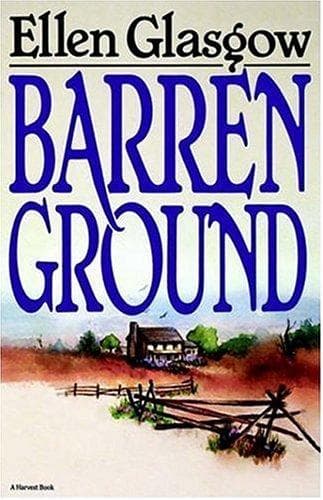
Country life -- Fiction; Pastoral fiction; Piedmont (U.S. : Region) -- Fiction; Virginia -- Fiction
Her street clothes were so uncomfortable that she wondered how she could
ever have worn them. Her stockings were too large, and the feet of them
were drawn out of shape; her dress felt as if it weighed tons. But her
hair troubled her most. No matter how hard she tried, she could not make
it look neat. So much of it had been cut away on the right side that she
was obliged to wind what was left into a thin twist and fasten it like a
wreath round her head. Her face was thin and pallid, just the shape and
colour of an egg, she thought despondently, and "I'm all eyes," she
added, while she gazed at herself in the small mirror.
It was late afternoon when she left the hospital, leaning on the arm of
the stranger, who remarked with every other step, "I hope you ain't
beginning to feel faint," or, "You'd better take it more slowly." The
bereaved woman was provided with a collection of gruesome anecdotes,
which she related with relish while they crept along the cross street in
the direction of Sixth Avenue. "There ain't much I don't know about
operations," she concluded at the end of her recital.
As the air brushed her face, Dorinda's first sensation was a physical
response to the invigorating frostiness. Then it seemed to her that
whenever she took a step forward the pavement rose slightly and slid up
to meet her. In so short a time she had forgotten the way to walk, and
she felt troubled because in her case the law of gravitation appeared to
be arbitrarily suspended. When she put her foot out, she did not know,
she told herself, whether it would have the weight to come down or would
go floating up into the air. "Could anything have happened to my brain,"
she wondered, "when I was struck on the head?" In a little while,
however, the sensation of lightness gave place to the more familiar one
of strained muscles. Though she could walk easily now, she was beginning
to feel very tired, and she could barely do more than crawl over the
long block.
A high wind was blowing from the west, billowing the sleeves and skirts
of women's dresses, whipping the dust into waves, and tossing the gay
streamers in Fifth Avenue. The sunlight appeared to splinter as it
struck against the crystal blue of the sky and to scatter a shower of
sparkling drops on the city. Though it was all bright, gay, beautiful,
to Dorinda the scene might have been made of glass in the windy hollow
of the universe. "I'm dried up at the core," she thought, "and yet, I've
got to go on pretending that I'm alive, that I'm like other people." She
felt nothing; she expected nothing; she desired nothing; and this
insensibility, which was worse than pain, had attacked her body as well
as her heart and mind. "If somebody were to stick a pin in me, I
shouldn't feel it," she told herself. "I'm no better than a dead tree
walking."
At the corner of Sixth Avenue, a gust of wind struck her sharply, and
still leaning on the arm of her companion, she drew back into the
shelter of a shop.
Public-domain text, read in full here on John Shaqi.
Reviews
Reviews
No reviews yet
Be the first to share your thoughts on this work.
Elsewhere in the archive
Join the Discussion
Join the discussion
Sign in to leave a comment or review.
Sign InorCreate an account