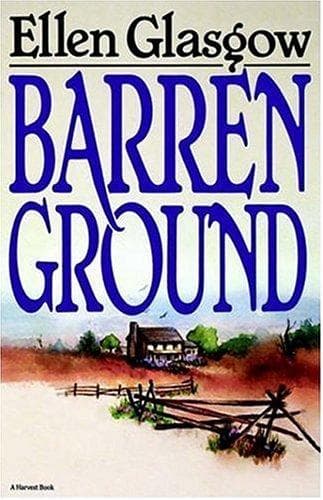
Country life -- Fiction; Pastoral fiction; Piedmont (U.S. : Region) -- Fiction; Virginia -- Fiction
"Well, it's a pity. I'm glad I don't have to struggle with fear." A
little later, as she drove across the railway tracks and down the long
slope in the direction of Old Farm, she reflected dispassionately upon
the crookedness of human affairs. Why had that honest farmer, robust,
handsome, without an idea above bulls and clover, mated with a woman who
was afraid of a grasshopper? And why had she, in whom life burned so
strong and bright, wasted her vital energy on the mere husk of a man?
Why, above all, should Nature move so unintelligently in the matter of
instinct? Did this circle of reasoning lead back inevitably, she
wondered, to the steadfast doctrine of original sin? "The truth is we
always want what is bad for us, I suppose," she concluded, and gave up
the riddle.
Just beyond the station, in front of the "old Haney place," she met
William Fairlamb, and stopped to ask him about repairing the cow-barn
and the henhouse. He was a tall, stooped, old-looking young man, with
shaggy flaxen hair and round grey eyes as opaque as pebbles. Though his
expression was stupid, he had intelligence above the ordinary, and was
the best carpenter at Pedlar's Mill.
"If you're going to keep cows, you'd better see that Doctor Greylock
mends his fences," he said, after he had promised to begin on the
cow-barn as soon as he had finished his contract with Ezra Flower. "That
old black steer of his is a public nuisance. I've had him wandering over
my wheat-fields all winter. It's a mortal shame the way the Greylocks
are letting that farm peter out."
"Yes, it's a shame," she agreed, and drove on again. Wherever she
turned, it appeared that she was to be met by a reminder that Jason was
living so near her. "If only he were dead," she thought, as impersonally
as if she were thinking of the black steer that trampled the ploughed
fields. "I shall have to go on hearing about him now until the end of my
days."
There was no regret, she told herself, left in her memory; yet whenever
she heard his name, or recalled his existence, her spirits flagged
beneath an overpowering sense of futility. At such moments, she was
obliged to spur her body into action. "It will be like this always,
until one of us is dead," she reflected. Though she neither loved nor
hated him now, the thought of him, which still lived on in some obscure
chamber of her mind, was sufficient to disturb and disarrange her whole
inner life. The part of her consciousness that she could control she had
released from his influence; but there were innate impulses which were
independent of her will or her emotions; and in these blind instincts of
her being there were even now occasional flashes of longing. While she
was awake she could escape him; but at night, when she slept, she would
live over again all the happiest hours she had spent with him. Never the
pain, never the cruelty of the past; only the beauty and the
unforgettable ecstasy came back to her in her dreams.
Public-domain text, read in full here on John Shaqi.
Reviews
Reviews
No reviews yet
Be the first to share your thoughts on this work.
Elsewhere in the archive
Join the Discussion
Join the discussion
Sign in to leave a comment or review.
Sign InorCreate an account