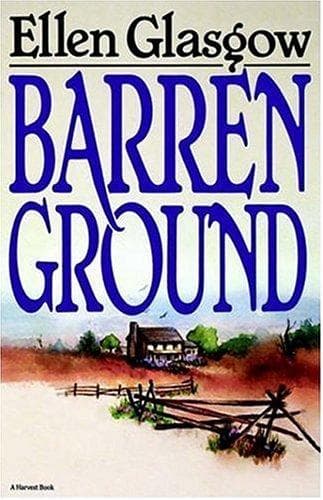
Country life -- Fiction; Pastoral fiction; Piedmont (U.S. : Region) -- Fiction; Virginia -- Fiction
There were times when it seemed to Dorinda that she could not breathe
within the stark limitations of her mother's point of view. As she ran
out of the room and the house, without heeding Mrs. Oakley's request
that she should wear a hat at least on the day of the funeral, she asked
herself if this aimless nagging was all that she could expect in the
future. She was fond of her mother; but fondness, strangely enough, did
not seem to make it easier for people to bear one another's tempers.
The path to Poplar Spring ran beside the eighteen-acre field, and she
stopped amid the dusty fennel and ragweed to inspect the work of the
last two days. The broomsedge had been partly cut down and burned, and
the blackened ruins waited now for the final obliteration. "It will be
hard work to get good grass here," she thought, "but if I keep turning
cowpeas under, I may bring up the soil in time." In the pasture, beyond
a rail fence, the grass was rank and high, for only Dan and Beersheba
had grazed there for the last four or five years. The solitary cow, when
they were fortunate as to own one, lived on the lawn or what was called
"the home field," where Mrs. Oakley milked in summer. Across the road
she saw the scantily fenced west meadow, where her father had sown his
winter wheat, and her eyes filled with tears as she gazed on the
sprinkling of green over the earth. While she stood there she remembered
the look on his face when he lay in his coffin; a look which was
austere, inaccessible, with a reproachful wonder beneath its mask of
solemnity, as if he were still asking life why it had crushed him.
"Whatever I give, the farm will be always mine," she thought. "That was
the way he felt. The farm isn't human and it won't make you suffer. Only
human things break your heart." Everything appeared so simple when she
regarded it through the film of sentiment that obscured her judgment.
Kinship with the land was filtered through her blood into her brain; and
she knew that this transfigured instinct was blended of pity, memory,
and passion. Dimly, she felt that only through this fresh emotion could
she attain permanent liberation of spirit.
Moving away, she followed the path which threaded the scrub pines on the
border of the broomsedge. Presently she distinguished the blur of Poplar
Spring in the distance, and toward the east the acres of fair timber
which had matured since her great-grandfather's death. In her new
reverence for her father she shrank from cutting down the tall trees.
"It would be slaughter," she said to herself. "I'll let the woods stand
as long as I can."
Overhead, the pines were soughing in a light wind, and for a moment or
two the sound of footsteps behind her was scarcely louder than the
whispering trees. Then, with a start, she realized that she was
followed, and glancing round, she saw Jason walking over the scarred
field.
Public-domain text, read in full here on John Shaqi.
Reviews
Reviews
No reviews yet
Be the first to share your thoughts on this work.
Elsewhere in the archive
Join the Discussion
Join the discussion
Sign in to leave a comment or review.
Sign InorCreate an account