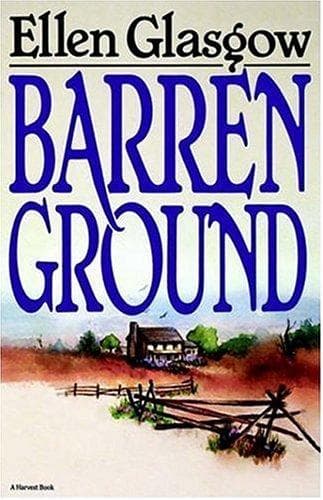
Country life -- Fiction; Pastoral fiction; Piedmont (U.S. : Region) -- Fiction; Virginia -- Fiction
Crow's feet! She turned with a start from the brood of white turkeys she
was counting. Yes, she was too young, she was only thirty-three, but she
was already beginning to break. Youth was going! Youth was going, the
words echoed and reechoed through the emptiness of the future. Week by
week, month by month, year by year, youth was slipping away; and she had
never known the completeness, the fulfilment, that she had expected of
life. Even now, she could not tell herself, she did not know, what it
was that she had missed. It was not love, nor was it motherhood. No, the
need went deeper than nature. It lay so deep, so far down in her hidden
life, that the roots of it were lost in the rich darkness. Though she
felt these things vaguely, without thinking that she felt them, it
seemed to her, standing there with her gaze on the brood of white
turkeys, that all she had ever hoped for or believed in was eluding her
grasp. In a little while, with happiness still undiscovered, she would
be as wrinkled and grey as her mother. Only her mother's restless habit
of work would remain to fill the vacancy of her days.
"I've been working too hard, Fluvanna," she said, "and what do I get out
of it?"
"You oughtn't to let yo'self go, Miss Dorindy. There ain't any use in
the world for you to slave and stint the way you do. You ought to go
about mo' and begin to take notice."
Dorinda laughed. "You talk as if I were a widower."
"Naw'm, I ain't. No widower ever lived the way you do."
"It's true. I haven't bought a good dress or been anywhere for ten
years."
"Thar ain't a particle of use in it. You'll be old and dried up soon
enough. What's the use of being young and proud if you don't strut?"
Yes, Fluvanna was right. What was the use? She had made a success of her
undertaking; but it was inadequate because there were no spectators of
her triumph. She had kept so close to the farm that her neighbours knew
her only as a dim figure against the horizon, a moving shape among
corn shocks and hay ricks in the flat landscape, an image that vanished
with these inanimate objects in the lengthening perspective. Even in the
thin and isolated community in which she lived, she did not stand out,
clearly projected, like James Ellgood; perhaps, for the simple reason,
she told herself now, that she had drilled her energy down into the soil
instead of training it upward.
"I believe you're right, Fluvanna," she said. "Now that we're out of
debt and things are going fairly well, I ought to try to get something
out of life while I'm still young."
Public-domain text, read in full here on John Shaqi.
Reviews
Reviews
No reviews yet
Be the first to share your thoughts on this work.
Elsewhere in the archive
Join the Discussion
Join the discussion
Sign in to leave a comment or review.
Sign InorCreate an account