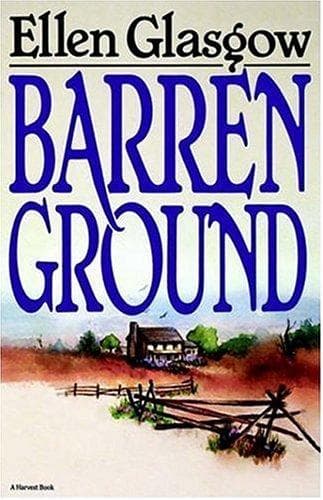
Country life -- Fiction; Pastoral fiction; Piedmont (U.S. : Region) -- Fiction; Virginia -- Fiction
Suddenly, it seemed to Dorinda that her impressions of the actual scene
dissolved and slipped like quicksilver from her mind. She ceased to
look, ceased to think, overcome by an emotion which was not grief,
though it was the very essence of sadness. Closing her eyes, she waited
for some sound or touch that would restore the fading glow of her
reason. Why was she here? Where was it leading her? What was the meaning
of it all?
She heard a strangled voice gasp, "You're hurting me," and looking round
she saw that the doctor and John Abner were carrying Jason to the car.
"You'll feel better presently," the doctor said soothingly. "I'll give
you something for the pain."
Like an automaton, she followed them; like an automaton, she stepped
into the car and took her place by Jason's side on the back seat. She
had intended to drive home, but she knew that she was incapable of
controlling the big car. "Some one had better be back here with him,"
the doctor had insisted, and she had obeyed his directions in silence.
"I've put the whiskey under the rug. Give him an eggnog as soon as you
put him to bed."
The car started slowly, and they had driven for some miles before she
found sufficient courage to turn and look at the figure beside her.
Dazed by the sedative, he was staring straight in front of him,
oblivious of the autumn sunshine, oblivious of the uninteresting
country, oblivious of her presence, lost beyond reach in that dark
labyrinth of sensation. His face was the face of one who had come to the
edge of the world and looked over. It expressed not pain, not despair
even, but nothingness. A grey woollen comforter was tied over his head,
and his features appeared to have fallen away beneath the mummy-like
covering. He was neither young nor old, she saw; he was over and done
with, a thing with which time had finished. And he was a stranger to
her! She had never loved him; she had never known him until to-day. The
weight on her heart was so heavy that it was suffocating her. Again she
thought: "Why am I here? What is the meaning of it all?" Again she felt
as she had felt at her father's death: "The pathos of life is worse than
the tragedy."
They drove on in silence; but it was a silence that reverberated like
thunder in her brain. Nothing and everything was over. Ahead of her the
road sank between the autumn fields and the brilliant patches of woods.
The blue haze swam before her in the direction of the river. They passed
the same ragged white and black children, who held up the same withered
flowers. The same labourers were at work in the fields, bent in the same
gestures of ploughing. As they went by a house set far back from the
road, with a little crooked path leading up to a white wicket-gate, she
imagined herself walking up the path and through the wicket-gate into
another life.
John Abner looked back. "Am I going too fast? He coughs as if he were
choking."
Public-domain text, read in full here on John Shaqi.
Reviews
Reviews
No reviews yet
Be the first to share your thoughts on this work.
Elsewhere in the archive
Join the Discussion
Join the discussion
Sign in to leave a comment or review.
Sign InorCreate an account