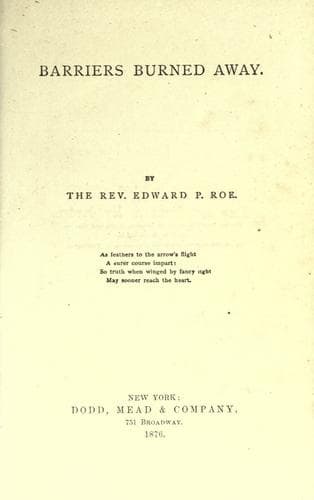
Chicago (Ill.) -- History -- To 1875 -- Fiction; Fires -- Fiction; Great Fire, Chicago, Ill., 1871 -- Fiction; Historical fiction
Left alone, Christine bowed her white face in her hands and sat so
still that it seemed as if life had deserted her. In her morbid state
she began to fancy herself the victim of some terrible fatality. Her
heart had bounded when Susie Winthrop was announced, believing that
from her she would gain sympathy; but in strange perversity she had
hidden her trouble from her friend, and permitted her to go away in
coldness. Christine could see as quickly and as far as any, and from
the first had noted that Dennis was very interesting to her friend.
Until of late she had not cared, but now for some reason the fact was
not pleasing, and she felt a sudden reluctance to speak to Susie of
him.
Now that she was alone a deeper sense of isolation came over her than
she had ever felt before. Her one confidential friend had departed,
chilled and hurt. She made friends but slowly, and, having once become
estranged, from her very nature she found it almost impossible to make
the first advances toward reconciliation.
Soon she heard her father's steps, and fled to her room to nerve herself
for the part she must act before him. But she was far from successful;
her pale face and abstracted manner awakened his attention and his
surmises as to the cause. Having an engagement out, he soon left her
to welcome solitude; for when she was in trouble he was no source of
help or comfort.
Monday dragged wearily to a close. She tried to work, but could not.
She took up the most exciting book she could find, only to throw it
down in despair. Forever before the canvas or the page would rise a
pale thin face, at times stern and scornful, again full of reproach,
and then of pleading.
Even at night her rest was disturbed, and in dreams she heard the
mutterings of his delirium, in which he continually charged her with
his death. At times she would take his picture from its place of
concealment, and look at it with such feelings as would be awakened
by a promise of some priceless thing now beyond reach forever. Then
she would become irritated with herself, and say, angrily: "What is
this man to me? Why am I worrying about one who never could be much
more to me living than dead? I will forget the whole miserable affair."
But she could not forget. Tuesday morning came, but no relief. "Whether
he lives or dies he will follow me to my grave!" she cried. "From the
time I first spoke to him there has seemed no escape, and in strange,
unexpected ways he constantly crosses my path!"
She felt that she must have some relief from the oppression on her
spirit. Suddenly she thought of Ernst, and at once went to the store
and asked if he had heard anything later. He had not, but thought that
his mother would receive a letter that day.
"I want to see your father's picture, and will go home that way, if
you will give me the number."
The boy hesitated, but at last complied with her wish.
Public-domain text, read in full here on John Shaqi.
Reviews
Reviews
No reviews yet
Be the first to share your thoughts on this work.
Elsewhere in the archive
Join the Discussion
Join the discussion
Sign in to leave a comment or review.
Sign InorCreate an account