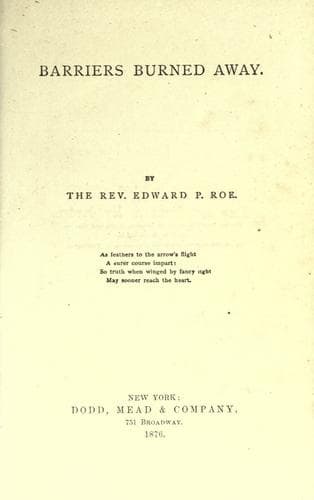
Chicago (Ill.) -- History -- To 1875 -- Fiction; Fires -- Fiction; Great Fire, Chicago, Ill., 1871 -- Fiction; Historical fiction
The boy's lip quivered at the mention of that name, and he answered,
hastily: "Fader wrote moder Mr. Fleet was no better. I fear he die;"
and in an agony of grief he turned and ran sobbing away.
From under her veil Christine's tears were falling fast also, and she
entered her elegant home as if it had been a prison.
CHAPTER XXXIV
REGRET
The next day was the Sabbath, and a long, dreary one it was to
Christine. But late in the afternoon Susie Winthrop came with a pale,
troubled face.
"Oh, Christine, have you heard the news?" she exclaimed.
Christine's heart stood still with fear, but by a great effort she
said, composedly, "What news?"
"Mr. Fleet has gone home very ill; indeed, he is not expected to live."
For a moment she did not answer, and when she did it was with a voice
unnaturally hard and cold: "Have you heard what is the matter?"
Miss Winthrop wondered at her manner, but replied, "Brain fever, I am
told."
"Is he delirious?" asked Christine, in a low tone.
"Yes, all the time. Ernst, the little office-boy, told me he did not
know his own mother. It seems that the boy's father is with Mrs. Fleet,
helping take care of him."
Christine's face was averted and so colorless that it seemed like
marble.
"Oh, Christine, don't you care?" said Susie, springing up and coming
toward her.
"Why should I care?" was the quick answer.
Susie could not know that it was in reality but an incoherent cry of
pain--the blind, desperate effort of pride to shield itself. But the
tone checked her steps and filled her face with reproach.
"Perhaps you have more reason to care than you choose to admit," she
said, pointedly.
Christine flushed, but said, coldly: "Of course I feel an interest in
the fate of Mr. Fleet, as I do in that of every passing acquaintance.
I feel very sorry for him and his friends"; but never was sympathy
expressed in a voice more unnaturally frigid.
Susie looked at her keenly, and again saw the tell-tale flush rising
to her cheek. She was puzzled, but saw that her friend had no confidence
to give, and she said, with a voice growing somewhat cold also: "Well,
really, Christine, I thought you capable of seeing as much as the rest
of us in such matters, but I must be mistaken, if you only recognized
in Dennis Fleet a passing acquaintance. Well, if he dies I doubt if
either you or I look upon his equal again. Under right influences he
might have been one of the first and most useful men of his day. But
they need not tell me it was overwork that killed him. I know it was
trouble of some kind."
Christine was very pale, but said nothing; and Susie, pained and
mystified that the confidence of other days was refused, bade her
friend a rather cold and abrupt adieu.
Public-domain text, read in full here on John Shaqi.
Reviews
Reviews
No reviews yet
Be the first to share your thoughts on this work.
Elsewhere in the archive
Join the Discussion
Join the discussion
Sign in to leave a comment or review.
Sign InorCreate an account