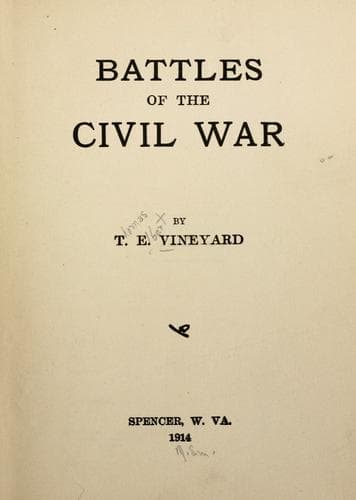
United States -- History -- Civil War, 1861-1865 -- Campaigns
Generals McClellan, Jackson, A. P. Hill, G. W. Smith, Joseph E.
Johnston and Lee, as well as other commanding officers of this series
of battles about Richmond, had been great friends. Some of them had
attended school together at West Point, and many of them had enjoyed
each other's fellowship while members of the Aztec Club in the City
of Mexico, which was an organization of American officers, while for
a few months they were in the Mexican capital at the close of the
Mexican war. General Franklin Pierce was president of the club, who was
afterwards President of the United States.
Generals McClellan and Joseph E. Johnston were special friends even
after the war, and in a conversation with McClellan Johnston remarked
"You never know what is in a man until you try to lick him."
THE BATTLE OF CEDAR MOUNTAIN
After the failure of McClellan's Peninsula campaign General John Pope
was called from the West to Washington to take charge of the Union
forces, and arrived in June, 1862. A new army was made up from the
respective divisions of McDowell, Banks and Fremont, which was to be
known as the Army of Virginia. General Pope at first refused to take
command of this army, for the reason that McDowell, Banks and Fremont
were superior officers in rank to himself, but was prevailed upon
to take the command, which he did, and in an address to his army he
ended with the statement, "My headquarters will be in the saddle."
When this was shown to General Lee, he grimly commented, "Perhaps his
headquarters will be where his hindquarters ought to be."
Fremont refused to serve under Pope, whom he considered his junior, and
resigned. His corps was assigned to General Sigel.
Pope's idea was to draw Lee's army away from following that of
McClellan down the peninsula, and advanced from Washington with
Gordonsville as his objective point. This place, being at the junction
of a railroad, was a base of supplies for the Southern army.
The sagacious Lee had divined his intentions and sent Stonewall Jackson
and Ewell to occupy this town. Ewell arrived in advance of Jackson, and
held the town. Jackson, coming up later, took full command of the army.
On July 27th, A. P. Hill also joined him with his corps, which brought
their strength up to about 25,000 men.
The Union army now occupied that portion of the country around Culpeper
Court House. Pope soon found that his brilliant success in the West was
not like measuring swords with the Confederate generals in Virginia.
Public-domain text, read in full here on John Shaqi.
Reviews
Reviews
No reviews yet
Be the first to share your thoughts on this work.
Join the Discussion
Join the discussion
Sign in to leave a comment or review.
Sign InorCreate an account