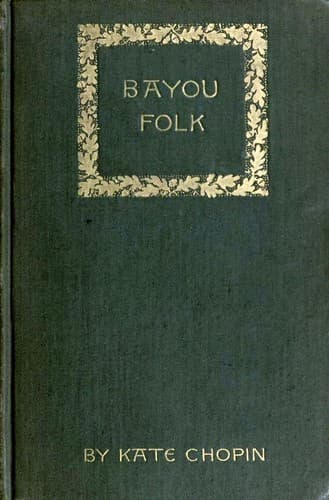
Louisiana -- Social life and customs -- Fiction; Short stories, American
"Did n' I done put de las' roostah in de pot?" she cried with
exasperation. "Now you come axen me fu kill de hen'! W'ere I goen to
fine aigg' to trade wid, w'en de hen' be gone? Is I got one picayune in
de house fu trade wid, me?"
"Papa," piped the young Jacques, "w'at dat I yeard you drive in de
yard, w'ile go?"
"Dat's it! W'en Lolotte would n' been talken' so fas', I could tole you
'bout dat job I got fu to-morrow. Dat was Joe Duplan's team of mule'
an' wagon, wid t'ree bale' of cotton, w'at you yaird. I got to go soon
in de mo'nin' wid dat load to de landin'. An' a man mus' eat w'at got
to work; dat's sho."
Lolotte's bare brown feet made no sound upon the rough boards as she
entered the room where Nonomme lay sick and sleeping. She lifted the
coarse mosquito net from about him, sat down in the clumsy chair by the
bedside, and began gently to fan the slumbering child.
Dusk was falling rapidly, as it does in the South. Lolotte's eyes grew
round and big, as she watched the moon creep up from branch to branch
of the moss-draped live-oak just outside her window. Presently the
weary girl slept as profoundly as Nonomme. A little dog sneaked into
the room, and socially licked her bare feet. The touch, moist and warm,
awakened Lolotte.
The cabin was dark and quiet. Nonomme was crying softly, because the
mosquitoes were biting him. In the room beyond, old Sylveste and the
others slept. When Lolotte had quieted the child, she went outside to
get a pail of cool, fresh water at the cistern. Then she crept into bed
beside Nonomme, who slept again.
Lolotte's dreams that night pictured her father returning from work,
and bringing luscious oranges home in his pocket for the sick child.
When at the very break of day she heard him astir in his room, a
certain comfort stole into her heart. She lay and listened to the faint
noises of his preparations to go out. When he had quitted the house,
she waited to hear him drive the wagon from the yard.
She waited long, but heard no sound of horse's tread or wagon-wheel.
Anxious, she went to the cabin door and looked out. The big mules were
still where they had been fastened the night before. The wagon was
there, too.
Her heart sank. She looked quickly along the low rafters supporting the
roof of the narrow porch to where her father's fishing pole and pail
always hung. Both were gone.
"'T ain' no use, 't ain' no use," she said, as she turned into the
house with a look of something like anguish in her eyes.
When the spare breakfast was eaten and the dishes cleared away, Lolotte
turned with resolute mien to the two little brothers.
"Veveste," she said to the older, "go see if dey got co'n in dat wagon
fu feed deni mule'."
"Yes, dey got co'n. Papa done feed 'em, fur I see de co'n-cob in de
trough, me."
"Den you goen he'p me hitch dem mule, to de wagon. Jacques, go down de
lane an' ax Aunt Minty if she come set wid Nonomme w'ile I go drive dem
mule' to de landin'."
Public-domain text, read in full here on John Shaqi.
Reviews
Reviews
No reviews yet
Be the first to share your thoughts on this work.
Join the Discussion
Join the discussion
Sign in to leave a comment or review.
Sign InorCreate an account