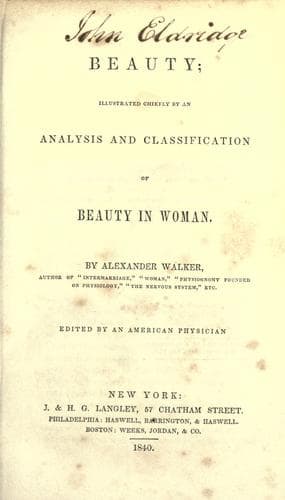
Beauty: Illustrated Chiefly by an Analysis and Classification of Beauty in WomanWalker, Alexander
Philosophy
Beauty: Illustrated Chiefly by an Analysis and Classification of Beauty in Woman
Walker, Alexander
Beauty, Personal; Women
Winckelmann, indeed, observes that the head of Scipio the elder, in the
Palazzo Rospigliosi, executed in basalt of a deep green, is very
beautiful. But, in that case, it is the form, not the color, of the head,
that is beautiful. While greenness of complexion would not be beautiful in
a man, it would certainly be hideously ugly in a woman.
Moreover, while, in a dead black or any dark color of face, it cannot be
pretended that, considering its color only, we should have more than
blackness or darkness for admiration, it is evident that, in a fair
complexion, we have, in addition to its general brilliance or splendor,
the infinite variety of its teints, their exquisite blendings, and the
beautiful expression of every transient emotion.
I have now only to expose the sophistry which Payne Knight has employed
upon this subject.
"I am aware," he says, "indeed, that it would be no easy task to persuade
a lover that the forms upon which he dotes with such rapture, are not
really beautiful, independent of the medium of affection, passion, and
appetite, through which he views them. But before he pronounces either the
infidel or the skeptic guilty of blasphemy against nature, let him take a
mould from the lovely features or lovely bosom of this masterpiece of
creation, and cast a plum-pudding in it (an object by no means disgusting
to most men's appetite), and I think he will no longer be in raptures with
the form, whatever he may be with the substance."
Now, it happens that a grosser incongruity can scarcely be supposed than
that which exists between lovely features or a lovely bosom and a
plum-pudding, or between the sentiment of love and the propensity to
gluttony; and therefore to place the substance of the pudding, in which
internal composition is alone of importance, and shape of none, under the
form of features or a bosom, in which internal structure is unknown or
unthought of, and shape or other external properties are alone considered,
is a gross and offensive substitution, intended, not to enlighten judgment
respecting form, but to pervert it, and to degrade the higher object by
comparison with the lower one. The shape, moreover, is a true sign in the
one case, and a false one in the other.--Of nearly similar character is
the following:--
"If a man, perfectly possessed both of feeling and sight--conversant with,
and sensible to the charms of women--were even to be in contact with what
he conceived to be the most beautiful and lovely of the sex, and at the
moment when he was going to embrace her, he was to discover that the parts
which he touched only were feminine or human; and that, in the rest of her
form, she was an animal of a different species, or a person of his own
sex, the total and instantaneous change of his sentiments from one extreme
to another, would abundantly convince him that his sexual desires depended
as little upon that abstract sense of touch, as upon that of sight."
Public-domain text, read in full here on John Shaqi.
Reviews
Reviews
No reviews yet
Be the first to share your thoughts on this work.
Elsewhere in the archive
Join the Discussion
Join the discussion
Sign in to leave a comment or review.
Sign InorCreate an account