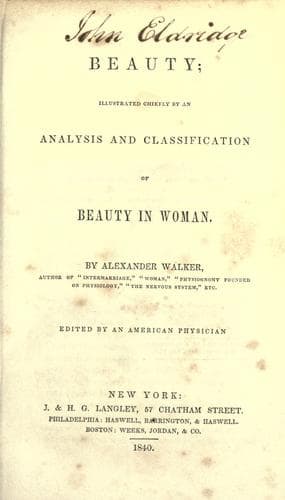
Beauty: Illustrated Chiefly by an Analysis and Classification of Beauty in WomanWalker, Alexander
Philosophy
Beauty: Illustrated Chiefly by an Analysis and Classification of Beauty in Woman
Walker, Alexander
Beauty, Personal; Women
That, in detecting an imposture of this kind, admiration would give place
to disgust, only proves that the external qualities which were admired
were the natural and appropriate signs of the internal qualities expected
to be found under them, and that they now cease to interest only because
they have become, not naturally less the signs of these qualities, but
because they have by a mere trick been rendered insignificant, because
truth and nature have been violated, and because the mind feels only
disgust at the imposture. I cannot help saying that if Knight was in
earnest when he framed such arguments, his mind was sometimes dull as well
as perverse.
"The redness of any morbid inflammation," he says, "may display a
gradation of teint, which, in a pink or a rose, we should think as
beautiful as 'the purple light of love and bloom of young desire;' and the
cadaverous paleness of death or disease, a degree of whiteness, which, in
a piece of marble or alabaster, we should deem to be as pure, as that of
the most delicate skin of the fairest damsel of the frigid zone:
consequently, the mere visible beauty is in both the same; and the
difference consists entirely in mental sympathies, excited by certain
internal stimuli, and guided by habit."
There is here the same confusion of heterogeneous and inconsistent
objects, as in the preceding cases. To judge of beauty in simple objects,
each quality may be separately considered; and in this view, if the
inflammation presented the same teint as the pink or the rose, then, as a
mere teint, abstracted from every other quality of the respective
objects, it would be precisely as beautiful in the one as in the other;
but as the color of a rose on the human body would indicate that flow of
blood to the skin which can result only from excessive action, it ceases
to be considered intrinsically, and is regarded only as a sign of disease.
The same observations are applicable to the other case here adduced.
"The African black," he says, "when he first beholds an European
complexion, thinks both its red and white morbid and unnatural, and of
course disgusting. His sunburnt beauties express their modesty and
sensibility by variations in the sable teints of their countenances, which
are equally attractive to him, as the most delicate blush of red to us."
Public-domain text, read in full here on John Shaqi.
Reviews
Reviews
No reviews yet
Be the first to share your thoughts on this work.
Elsewhere in the archive
Join the Discussion
Join the discussion
Sign in to leave a comment or review.
Sign InorCreate an account