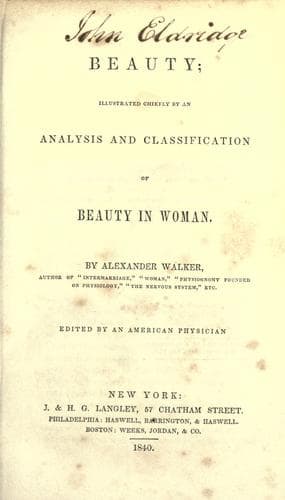
Beauty: Illustrated Chiefly by an Analysis and Classification of Beauty in WomanWalker, Alexander
Philosophy
Beauty: Illustrated Chiefly by an Analysis and Classification of Beauty in Woman
Walker, Alexander
Beauty, Personal; Women
The simple temperaments are therefore abstractions, which it is difficult
to realize; and the influence of any temperament is sometimes
undiscoverable except in some extraordinary circumstances of disorder or
disease, during which it may be observed.
Cullen admits the four temperaments of Hippocrates, and remarks concerning
them, that it is probable they were first founded upon observation, and
afterward adapted to the theory of the ancients, since we find they "have
a real existence."
Dr. Prichard remarks, that "this division of temperaments is by no means a
fanciful distinction."
To the four temperaments of Hippocrates, Gregory adds a fifth, the nervous
temperament.
Thus are formed five temperaments generally admitted, namely, 1st, the
phlegmatic or relaxed; 2d, the sanguine arterial; 3d, the sanguine venous
or bilious; 4th, the nervous; and, 5th, the muscular or athletic.
Some writers join to these the partial temperaments which determine the
ascendency of the functions exercised by particular organs; whence
principally come the temperaments which they call the cerebral,
epigastric, abdominal, hepatic, genital, &c.
As already said, it will in the sequel appear that some of these
temperaments are comparatively simple, that others are compound, and that
from this want of classification, their nature has been imperfectly
understood.[32]
CHAPTER XII.
FIRST SPECIES OF BEAUTY--BEAUTY OF THE LOCOMOTIVE SYSTEM.
The average stature of woman, as already said, is two or three inches less
than that of man.
The bones of woman remain always smaller than those of man; the
cylindrical ones being more slender, and the flat ones thinner, while the
former are also rounder. The muscles render the surfaces of the bones less
uneven; the projections of the latter are less; and all their cavities and
impressions have less depth. The bones of woman have likewise less
hardness than those of man.
Such being the solid and fundamental parts of this system in woman, the
most remarkable circumstances in their combination should next be noticed.
In woman, the magnitude of the pelvis or lower part of the trunk, has the
greatest influence on the apparent proportion of parts, and on the general
figure.
The most remarkable differences between the two sexes, in relation to this
system, are consequently those presented by the inferior and superior part
of the trunk in each. The breast and the haunches are in an inverse
proportion in the two sexes. Man has the breast larger and wider than that
of woman: woman has the haunches less circumscribed than those of man.
The upper part of the body is also less prominent, and the lower part more
prominent, in woman than in man; and therefore, when they stand upright,
or lie on the back, the breast is most prominent in the male, and the
pubes in the female. The indication this affords of the fitness of woman
for impregnation, gestation, and parturition, is obvious.
From the same cause, the back of woman is more hollow.
Public-domain text, read in full here on John Shaqi.
Reviews
Reviews
No reviews yet
Be the first to share your thoughts on this work.
Elsewhere in the archive
Join the Discussion
Join the discussion
Sign in to leave a comment or review.
Sign InorCreate an account