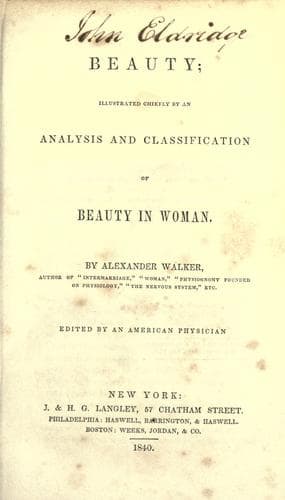
Beauty: Illustrated Chiefly by an Analysis and Classification of Beauty in WomanWalker, Alexander
Philosophy
Beauty: Illustrated Chiefly by an Analysis and Classification of Beauty in Woman
Walker, Alexander
Beauty, Personal; Women
The ancients classed individuals in one or other of four temperaments,
founded on the hypothesis of four humors, of which the blood was supposed
to be composed--the red part, phlegm, yellow and black bile. These were
regarded as the elements of the body, and their respective predominance
passed for the cause of the differences which it presented. Hence were
derived the names of the sanguine, the phlegmatic, the choleric, and the
melancholic temperament.
Although the hypothesis on which this doctrine was founded is universally
discarded, the phenomena which observation had taught the ancients, and
which they had hypothetically connected with these elements, were so true,
that that classification has been more or less employed in all the
hypotheses which have since been invented to explain their cause; and
their nomenclature has continued in use to the present day.
A temperament may be defined a peculiar state of the system, depending on
the relative proportion of its different masses, and the relative energy
of its different functions, by which it acquires a tendency to certain
actions.
The predominance of any particular organ or system of organs, its excess
of force, extends its sphere of activity to all the other functions, and
modifies them in a peculiar manner. Thus, conforming in the illustration
to the preceding arrangement, in one person, the muscles are more
frequently employed than the brain; in another, the stomach or the organs
of reproduction are more employed than the muscles; and in a third, the
brain and nerves are more employed than either. This predominance or
excess establishes the temperament.
The relative feebleness of any organ or system of organs, similarly forms
modifications not less important. Thus in one person, the organs of the
abdomen are less employed; in another, those of the chest; in a third, the
brain.
Disease, it is observed, "commonly enters into the organization by these
feeble points: death even attacks them first; extends afterward from one
to another; and makes progress more or less rapid, according to the
importance of the organ primitively affected."
Temperaments, however, vary infinitely. It may be said that every
individual has a peculiar one, to which he owes his mode of existence and
his degree of health, ability, and happiness.
The temperament, moreover, of each individual is not always characterized
by well-marked symptoms; and even where it has been strongly marked by
nature, education, age, the influence of climate, the exercise of
professions and trades, and various habits, produce in it infinite
changes.
Temperaments also combine together, so that all men are, in some degree,
at once sanguine and bilious, or otherwise compound. Thus all intermediate
shades of temperament are produced; and it is often difficult, or, under
particular circumstances, impossible, to determine under which temperament
individuals may be classed.
Public-domain text, read in full here on John Shaqi.
Reviews
Reviews
No reviews yet
Be the first to share your thoughts on this work.
Elsewhere in the archive
Join the Discussion
Join the discussion
Sign in to leave a comment or review.
Sign InorCreate an account