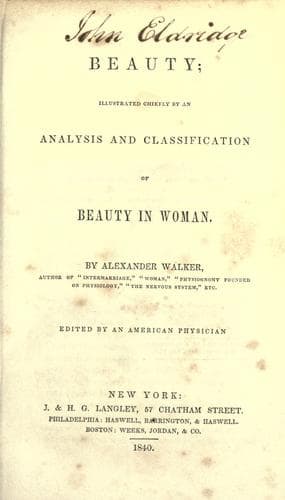
Beauty: Illustrated Chiefly by an Analysis and Classification of Beauty in WomanWalker, Alexander
Philosophy
Beauty: Illustrated Chiefly by an Analysis and Classification of Beauty in Woman
Walker, Alexander
Beauty, Personal; Women
In youth, however, one of the constituent parts of the skin, the reticular
tissue, or whatever the substance under the scarf-skin may be called,
appears to be more expanded, especially in women; and it would seem that
this tissue is then filled with a blood which is less dark, and which
forms the coloring of youth. This, differently modified by the
scarf-skin, gives the blue, the purple, and all the teints formed by these
and the color of the skin. Where the vessels are more patent, and the skin
more thin, delicate, and transparent, as in the cheeks, the hue of the
rose is cast over that of the lily. In addition to this, the slightest
emotions of surprise, of pleasure, of love, of shame, of fear, often
diversify all these teints.
Lightness of complexion, however, is probably dependant more particularly
on the arterial circulation, and darkness of complexion on the venous
circulation; for we know that in fairer woman the arteries possess greater
energy, while in darker man the veins are more developed, larger, and
fuller.
Farther confirmation of this is afforded by an observation, which
physiologists have neglected to make, that the kidneys, receiving arterial
blood, are the artery-relieving glands, while the liver, receiving venous
blood, is the vein-relieving gland. Now, it is certain that, in cold
climates, the urinary secretion and fairness prevail; while, in hot
climates, the hepatic secretion and darkness prevail. Many physiologists
have indeed made the insulated remark, that the dark complexion has much
to do with the hepatic secretion. The more abundant urinary and hepatic
secretions, however, may not be the causes, but only concomitant effects
of the same cause with fairness and darkness of complexion.
The SECOND MODIFICATION, therefore, of this species of beauty, is that in
which the circulating vessels, being moderately active and finely
ramified, bestow upon the skin a whiteness, a transparency, and a
complexion, which are necessary to beauty.
The whiteness, the transparency, and the color of the skin, have, in all
highly civilized nations, been deemed essential conditions of beauty.
The ancients regarded whiteness, in particular, as the distinctive
character of beauty; and they estimated that character so highly, that the
name of Venus, from the Celtic _ven_, _ben_, or _ban_, signifies white, or
whiteness; and Venus herself is said to be fair and golden-haired.
Among the civilized moderns, also a taste which women seek always to
satisfy, is that for whiteness of the skin: hence, the white lily,
new-fallen snow, white marble, or alabaster, are the images which poetry
employs, when the color of a woman is its subject. So greatly, indeed,
does whiteness contribute to beauty, that many women deemed beautiful by
us, have little other right to that epithet except what they derive from a
beautiful skin.
_Third Variety or Modification of this Species of Beauty._
Public-domain text, read in full here on John Shaqi.
Reviews
Reviews
No reviews yet
Be the first to share your thoughts on this work.
Elsewhere in the archive
Join the Discussion
Join the discussion
Sign in to leave a comment or review.
Sign InorCreate an account