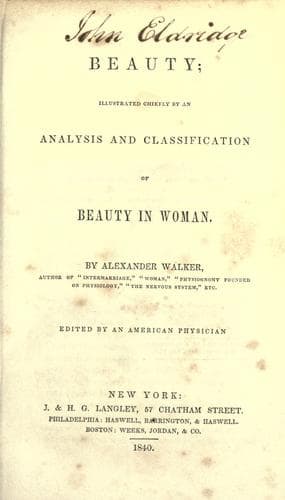
Beauty: Illustrated Chiefly by an Analysis and Classification of Beauty in WomanWalker, Alexander
Philosophy
Beauty: Illustrated Chiefly by an Analysis and Classification of Beauty in Woman
Walker, Alexander
Beauty, Personal; Women
The branches of the great artery of the body, the aorta, supplying the
abdomen and pelvis, are larger in woman than in man, as well as more
habitually liable to variation in the quantity of their contents. The
quantity of blood, also, which passes to the abdomen, is greater.
At the same time, the excretions are generally less in woman. Hippocrates
says: "_Nam corpus muliebre minus dissipatur quam virile_;" the
expenditure of the body of woman is less than that of man.
It is evident, then, that the secretions, nutrition, in particular, must
be greater. We actually know them to be so.
But the nourishment of the organs concerned in locomotion is less active,
and that of the cellular and adipose substance is generally more active,
than in man. And on this, important consequences depend.
Woman is subject to crises which would destroy all her organs, if they
offered too powerful a resistance. Some parts of her body are exposed to
great shocks, to alternate extensions, compressions, and reductions, which
could not take place with impunity, but by means of this predominance of
the cellular and adipose structure.
The cellular expansion, the general basis of the structure, appears then
to be more abundant in woman, more lax and yielding, more dilated and
fuller of liquids; and it is by yielding gradually, by decomposing and
weakening shocks by means of the general suppleness of the different
organs, thus procured, that nature seems, in woman, to avoid, or to
destroy, every hurtful effort.
It is observed, moreover, that certain parts, naturally more loose,
receive into all their vessels a more considerable quantity of liquid, and
assume a particular enlargement, at the moment when their sympathy with
the uterus causes them to enter into action in concert with it; and it is
also observed that they dilate more easily during pregnancy.
It is thus, then, that nature gives to all the parts of woman that
suppleness which renders her capable of easily yielding to the great
revolutions which affect her organization in regard to reproduction, as
well as mark the different periods of her life.
The great development of the cellular and fatty tissue in woman is
illustrated by the remarkable fact, that anciently the Romans, in order to
burn the bodies of dead men, were obliged to join to them those of women,
the fat of which greatly facilitated combustion.
Now, with the great purposes described above, beauty is naturally
associated. It is principally this excess of the cellular and fatty
tissues which gives to the members of woman those round and beautiful
outlines, that soft and polished surface, which the body of man does not
possess.
Public-domain text, read in full here on John Shaqi.
Reviews
Reviews
No reviews yet
Be the first to share your thoughts on this work.
Elsewhere in the archive
Join the Discussion
Join the discussion
Sign in to leave a comment or review.
Sign InorCreate an account