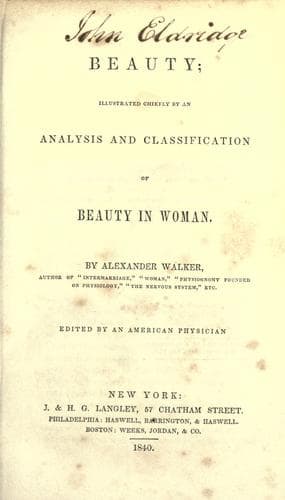
Beauty: Illustrated Chiefly by an Analysis and Classification of Beauty in WomanWalker, Alexander
Philosophy
Beauty: Illustrated Chiefly by an Analysis and Classification of Beauty in Woman
Walker, Alexander
Beauty, Personal; Women
Brown women, who probably have more of this oleaginous secretion, are said
to possess in a greater degree the polish of skin which gives impressions
so agreeable to the organ of touch; and hence, Winckelmann has said that
persons who prefer brown women to fair ones allow themselves to be
captivated by the touch rather than the sight. There is reason, however,
to doubt the accuracy of this. Brown women appear to have greater
softness, but less smoothness of skin.
The body of woman is nearly deprived of hairs upon all parts, except the
head, axillæ, &c.; and the hair of her head is generally long, fine, and
flexible.
The quantity and the color of the hair are always in relation to the
constitution of the individual to which it belongs, and generally to the
temperature of the place. The people of northern countries have the hair
of a silken fineness and of surprising length.
The hair which is most admired is not only very fine and flexible, but
light colored. Fair golden hair was, of all its teints, that which the
ancient artists preferred.
In woman, the hair of the head whitens and falls later than in man.
It is curious that, in regard to the hair, the distinctive characters of
the sexes should not always have been preserved. Though nature gives long
hair to woman, it has sometimes been the fashion to wear it short; and
though man has naturally shorter hair, it has sometimes been the fashion
to cherish its growth, and to shave the beard from his face. The latter
has especially been the case in degenerate and effeminate times; and this
has sometimes been accompanied by remarkable consequences.
One of the greatest misfortunes, says a French writer, which France ever
had to lament, the divorce of Louis le Jeune from Elinor of Guyenne,
resulted from the fashion, which this prince wished to introduce, of
shaving his chin and cropping his head. The queen, his wife, who appears
to have possessed, with a masculine beauty, considerable acuteness of
intellect, observed with some displeasure, that she imagined herself to
have espoused a monarch, not a monk. The obstinacy of Louis in shaving
himself, and the horror conceived by Elinor at the sight of a beardless
chin, occasioned France the loss of those fine provinces which constituted
the dowry of this princess; and which, devolving to England by a second
marriage, became the source of wars which desolated France during four
hundred years.
The habit of wearing the beard is a manly and noble one. Nature made it
distinctive of the male and female; and its abandonment has commonly been
accompanied not only by periods of general effeminacy, but even by the
decline and fall of states. They were bearded Romans who conquered the
then beardless Greeks; they were bearded Goths who vanquished the then
beardless Romans; and they are bearded Tartars who now promise once more
to inundate the regions occupied by the shaven and effeminate people of
western Europe.
Public-domain text, read in full here on John Shaqi.
Reviews
Reviews
No reviews yet
Be the first to share your thoughts on this work.
Elsewhere in the archive
Join the Discussion
Join the discussion
Sign in to leave a comment or review.
Sign InorCreate an account