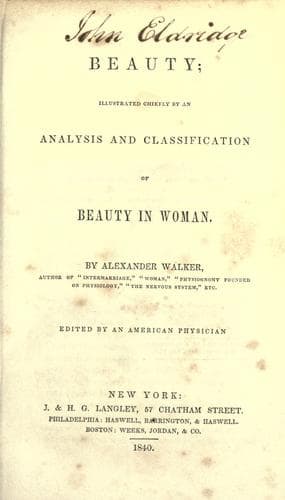
Beauty: Illustrated Chiefly by an Analysis and Classification of Beauty in WomanWalker, Alexander
Philosophy
Beauty: Illustrated Chiefly by an Analysis and Classification of Beauty in Woman
Walker, Alexander
Beauty, Personal; Women
In every part, however, of the human figure, as observed by Reynolds,
"when not spoiled by too great corpulency, will be found distinctness, the
parts never appearing uncertain or confused, or as a musician would say,
slurred; and all those smaller parts which are comprehended in the larger
compartment are still found to be there, however marked."
Now, while all this is the case, it appears that the true skin is much
thinner and more delicate in woman than in man, and that it derives more
or less of its clear whiteness from the quantity of fat which is below
it; for meagerness inevitably tarnishes and dries it. Hence, to possess a
fine, soft, white, and fresh skin, it is also indispensable to possess
plumpness.
In relation to this purer white, it must also be observed, that
transpiration, which might soil it, appears to be much less abundant in
woman; and that the liver or vein-relieving gland, is very large. The
excretions of the skin in women are indeed chiefly limited to certain
parts; and it is thence that it has, in various parts, an odor which a
French writer observes "it is difficult to describe, but which an
exercised sense of smell easily succeeds in distinguishing in women who
fully enjoy all the attributes of their sex, and who are women even in the
atmosphere which exhales from them."
While the skin is thus more white in women, it is also more transparent.
The reticular tissue, or substance interposed between the true skin and
scarf-skin, appears to have more clearness and turgescence, especially on
the face, where, under the influence of various emotions, it easily
permits a passage to the blood, as we see in blushing. It is in youth that
this turgescence and clearness are most evident.
Hence, the skin in woman less conceals the veins, of which the color, only
enfeebled or modified by the skin, "gives all those shades of azure which
the charmed eye follows with so much pleasure on the surface of the bosom
and of all the parts where the skin has least of thickness."
All this constitutes freshness, or animation, which is nearly synonymous
with health, and without which there is no beauty. When that quality, as
observed by Roussel, "is wanting, all other attractions strike but feebly,
because the prompt judgment, which instinct suggests, warns us that the
woman whose person does not present all the characters of perfect health,
is in a disposition little favorable to the plan of nature, relatively to
the maintenance of the species."
The whiteness and the animation of the skin, however, do not alone
constitute its beauty: there is still another quality which is absolutely
necessary to it. This is the softness and the polish which, as the reader
has seen, is one of the first conditions of physical beauty. In woman,
this is probably derived from a slight degree of oleaginous secretion.
Hence, she has few asperities of the skin, especially on the surface of
the bosom, and other parts, where the skin is excessively smooth.
Public-domain text, read in full here on John Shaqi.
Reviews
Reviews
No reviews yet
Be the first to share your thoughts on this work.
Elsewhere in the archive
Join the Discussion
Join the discussion
Sign in to leave a comment or review.
Sign InorCreate an account