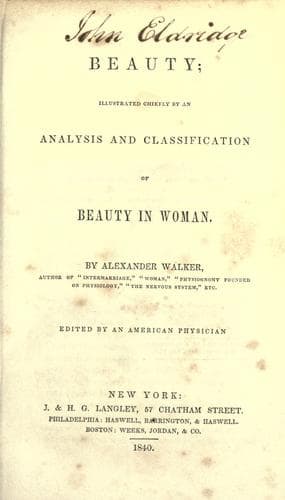
Beauty: Illustrated Chiefly by an Analysis and Classification of Beauty in WomanWalker, Alexander
Philosophy
Beauty: Illustrated Chiefly by an Analysis and Classification of Beauty in Woman
Walker, Alexander
Beauty, Personal; Women
It is characterized by the smallness and the emaciation of the muscles,
the quickness and intensity of the sensations, and the suddenness and
fickleness of the determinations.
It is seldom natural, but commonly depends on a sedentary and inactive
life, on a diseased condition of the brain produced by reading works of
imagination, and on habits of sensual indulgence. In confirmation of this,
we are told that the Roman ladies became subject to nervous affections
only in consequence of those depraved manners which marked the decline of
the empire; and that these affections were extremely common in France in
the licentious times preceding the fall of the corrupt and corrupting
monarchy.
Another partial view falling under this species, and properly under the
_second variety_, is the _cerebral temperament_, which results from the
energy and influence of the brain.
This temperament, being thus determined by an excess in the power of the
brain, has been called the temperament of genius. When it is increased by
education and habits, the other organs are generally more feeble.
In woman, the cerebral temperament is more particularly characterized by a
predominance of imagination, which is evidently dependant on the
organization which has already been described.
It has been truly observed, that to contribute to the perfection of reason
as well as to the preservation of health, the brain ought to be exercised
and developed in every direction; that the mere exercise of memory
carried too far renders persons foolish; that the predominance of
imagination disposes to nervous affections, and even to alienation; that
meditation alters the digestive functions; and that the dry and minute
contention which business requires, disposes, when joined to a defect of
exercise (and I may add the vinous excesses in which men of business
indulge), to apoplexy and to paralysis.
CHAPTER XV.
BEAUTY OF THE FACE IN PARTICULAR.
"It is probable," says Dr. Prichard, "that the natural idea of the
beautiful in the human person has been more or less distorted in almost
every nation. Peculiar characters of countenance, in many countries,
accidentally enter into the ideal standard. This observation has been made
particularly of the negroes of Africa, who are said to consider a flat
nose and thick lips as principal ingredients of beauty; and we are
informed by Pallas that the Kalmucs[40] esteem no face as handsome, which
has not the eyes in angular position, and the other characteristics of
their race. The Aztecs of Mexico have ever preferred a depressed
forehead,[41] which forms the strongest contrast to the majestic contour
of the Grecian busts: the former represented their divinities with a head
more flattened than it is ever seen among the Caribs, and the Greeks, on
the contrary, gave to their gods and heroes a still more unnatural
elevation."
Public-domain text, read in full here on John Shaqi.
Reviews
Reviews
No reviews yet
Be the first to share your thoughts on this work.
Elsewhere in the archive
Join the Discussion
Join the discussion
Sign in to leave a comment or review.
Sign InorCreate an account