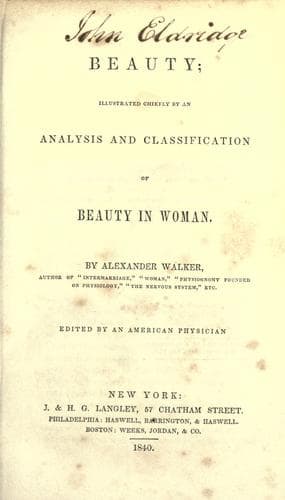
Beauty: Illustrated Chiefly by an Analysis and Classification of Beauty in WomanWalker, Alexander
Philosophy
Beauty: Illustrated Chiefly by an Analysis and Classification of Beauty in Woman
Walker, Alexander
Beauty, Personal; Women
Knowing, as the reader now does, what constitutes the worth, the dignity,
and the beauty, of the various organs, this statement tends to show the
value of that standard of beauty which we owe to the Greeks. I proceed to
illustrate it in regard to the FACE.
The beauty of the human countenance is described by various writers, as
including the beauty of form, in the various features of the face; the
beauty of color, in the shades of the complexion; the beauty of character,
in some distinctive and permanent relations; and the beauty of expression,
in some immediate and temporary feeling.
In regard to the form of the face, considered as a whole, the opening of
the facial angle of Camper, in measuring geometrically the extent of the
upper part of the head, marks the development of the brain or organ of
thought, and shows the proportion which it bears to the middle and lower
part of the face, or to the organs of sense and expression.
This development of the upper part of the head contributes essentially to
beauty, by giving to the whole head that pyriform appearance already
described, by which in every view it is larger at the superior part,
diminishes gradually as it descends, and terminates by the agreeable
outline of the chin.
In the most beautiful race of men, the facial angle extends to eighty-five
degrees, acquiring an increase of ten degrees above the inferior
varieties; the face is diminished; the eyes are better placed; the nose
assumes a more elegant form; and all appearance of muzzle vanishes.
In the Greek ideal head, the development presenting a facial angle of
ninety degrees, confers the highest beauty of the form of the head, the
majesty of the forehead, the position of the eyes upon a line which
divides the face into two equal parts, the elegant projection of the nose,
the absence of all tumidity of the lips.--But of that, in the sequel.
In the face, generally, as observed by Winckelmann, beauty of form depends
greatly upon the profile, and particularly on the line described by the
forehead and nose, by the greater or less degree of the concavity or
declivity of which, beauty is increased or diminished. The nearer the
profile approaches to a straight line, the more majestic, and at the same
time softer, does the countenance appear, the unity and simplicity of this
line being, as in everything else, the cause of this grand, yet soft
harmony.
The face being the seat of several organs, each must be examined in its
turn.
Winckelmann observes, that "a large high FOREHEAD [an excess, in this
respect] was regarded by the ancients as a deformity."--And "Arnobius
says, that those women who had a high forehead, covered a part of it with
a fillet." The reason of this will afterward be pointed out.
The sense of TOUCH resides in all parts of the face, but especially in
the lips. It is most perfect, however, at the tips of the fingers.
Public-domain text, read in full here on John Shaqi.
Reviews
Reviews
No reviews yet
Be the first to share your thoughts on this work.
Elsewhere in the archive
Join the Discussion
Join the discussion
Sign in to leave a comment or review.
Sign InorCreate an account