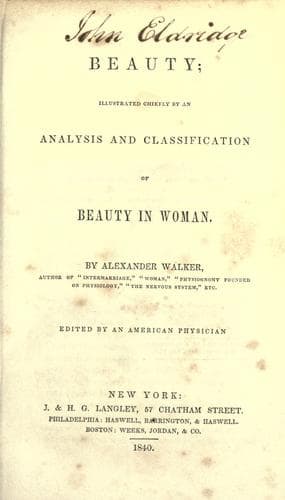
Beauty: Illustrated Chiefly by an Analysis and Classification of Beauty in WomanWalker, Alexander
Philosophy
Beauty: Illustrated Chiefly by an Analysis and Classification of Beauty in Woman
Walker, Alexander
Beauty, Personal; Women
The same writer says: "The flat compressed nose of the Kalmucs, Chinese,
and other distant nations, is also a defect, because it destroys the
harmony of forms, according to which all the other parts are constructed:
nor is there any reason why nature should compress and hollow it, instead
of continuing the straight line begun in the forehead." The fact is true;
the reasoning false, as will be seen in a subsequent chapter, to which
this point properly belongs.
Under the influence of passion, the nostrils expand and are drawn upward;
and these two motions are the only ones of which the lower and moveable
part of the nose is capable.
The sense of smell, like that of taste, is more delicate and more
exquisite in woman than in man. Woman accordingly enjoys more, and suffers
more, by that sense than man does; and its influence is said to dispose
her more than man to those pleasures which have remarkable relations to
that sense.
To beauty of the EYE, magnitude and elongated form contribute more perhaps
than color: if its form be bad, no color will render it beautiful. In
woman, however, the most beautiful eyes, in relation to color, are those
which appear to be blue, hazel, or black. But no color of the eye is
beautiful without clearness in every part.
"The more obliquely, and at an angle to each other," says Winckelmann,
"that the eyes are placed, as in cats, the more their position is removed
from the base, or from the fundamental lines of the human face, which form
a cross that divides it into four parts, the nose dividing it
perpendicularly into two equal parts, and the eyes dividing it
horizontally. When the eyes are placed obliquely, they form an angle with
a line parallel to that which we suppose to pass through their centre. And
this indeed is doubtless the reason why it displeases us to see a mouth
which goes awry, because it generally offends the eye to see two lines
diverging from each other without any reason. Thus eyes placed obliquely,
as may be seen sometimes among ourselves, and commonly among the Chinese,
Japanese, and in Egyptian heads, are an irregularity and a deformity."
Here, again, Winckelmann's fact is true, and his reasoning false, or
rather, perhaps, superficial. The real cause of the deformity of
obliquely-placed eyes is, that the vital parts of the head preponderate.
The cavities of the upper jaw, which open into the internal nose, are, in
the Mongelic races, so large, that they raise the cheek-bones, throw the
orbit upward at its lateral part, and encroach apparently upon the space
which should contain a nobler organ, the brain. The causes assigned by
Winckelmann are but consequences of this.
Public-domain text, read in full here on John Shaqi.
Reviews
Reviews
No reviews yet
Be the first to share your thoughts on this work.
Elsewhere in the archive
Join the Discussion
Join the discussion
Sign in to leave a comment or review.
Sign InorCreate an account