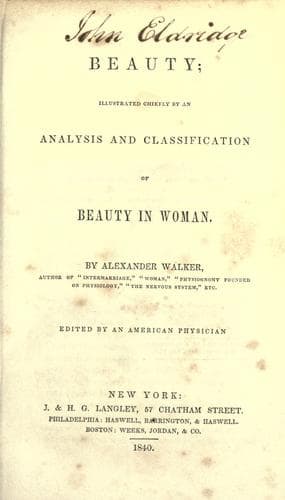
Beauty: Illustrated Chiefly by an Analysis and Classification of Beauty in WomanWalker, Alexander
Philosophy
Beauty: Illustrated Chiefly by an Analysis and Classification of Beauty in Woman
Walker, Alexander
Beauty, Personal; Women
The eyelids in woman, when well formed, present the gentlest inflexions.
The eyelashes, when long and silky, form a sign of gentleness, and
sometimes of softness. The eyebrows ought to be furnished with fine hairs,
arched, and separated: if they are too thin, they do not sufficiently
protect the organ of sight: if they unite, they render the physiognomy
sombre; their too-marked approximation, and their extreme separation, are
real deformities.
The sense of sight in woman is rapid and active; yet, in her, the slow and
languid motion of the eye is generally employed, and is more beautiful
than a brisk one. Woman requires a mild light, and colors of moderate
vividness, rather than otherwise.
The beauty of the EAR is too little regarded. To an experienced eye it
presents great beauties, and great deformities, in form, magnitude, and
projection.
The size and prominence of the ear, which characterize several nomadic
tribes, are contrary to beauty, not merely because they alter the
regularity of the oval of the head, and surcharge its outline with
prominences, but because they are in themselves ugly, indicating rather
the coarse strength common to inferior animals than the delicacy to be
found in man.
In woman, the ear is also more delicate, more sensible, but more feeble,
than in man. Strong sounds, loud noises, which may be agreeable to the ear
of man, are offensive to her. She prefers soft and tender, gay, or
pathetic music, to every other; and whatever may be the perfection of her
musical education, she also prefers sweet and tender melody to the most
complicated Sclavonic harmony.
Such are the organs of sense or those of impression, which form the first
and most important portion of the face of woman.--The organs of
expression, the MUSCLES of the face, on the contrary, are feeble in her;
and correspondingly feeble and rounded are the bony points to which they
are attached.
Woman presents very little prominence of the frontal sinuses; the
cheek-bones display beautiful curves; the edges of the alveoli containing
the teeth are much more elliptical than in man; and the chin is softly
rounded. Of the chin, it should be observed that it is a distinctive
character of the human species, and is not found in any other animal. When
well formed, it is full, united, and generally without a dimple; and it
passes gently and almost insensibly into the neighboring parts. In woman
especially, the chin ought to be finely rounded; for when projecting, it
expresses, owing to its connexion with muscular action and power, a
firmness and a determination which we do not wish to discover in her
character. "The apparent convexity of the cheeks," says Winckelmann,
"which in many heads appears greater than natural, contributes to this
rotundity: it is not, however, ideal, but taken from natural beauty."
Public-domain text, read in full here on John Shaqi.
Reviews
Reviews
No reviews yet
Be the first to share your thoughts on this work.
Elsewhere in the archive
Join the Discussion
Join the discussion
Sign in to leave a comment or review.
Sign InorCreate an account