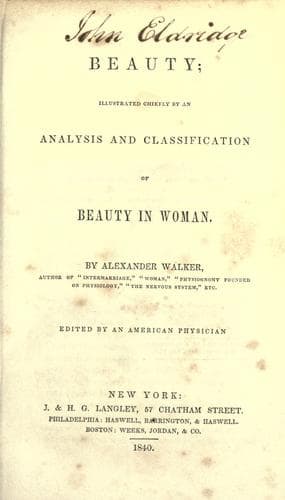
Beauty: Illustrated Chiefly by an Analysis and Classification of Beauty in WomanWalker, Alexander
Philosophy
Beauty: Illustrated Chiefly by an Analysis and Classification of Beauty in Woman
Walker, Alexander
Beauty, Personal; Women
I have said, already, that symmetry is a characteristic of thinking
beings, and I have explained the reason of this. The present case
admirably illustrates it. This symmetrical arrangement of the hair bestows
an intellectual air; and it well may, for, when natural, it derives its
tendency to fall on each side, from the top of the head, either from the
general elevation of the calvarium, or from the particular elevation of
the forehead, which is characteristic of beauty in woman.
It accordingly announces in the individual higher observing faculties:
hence, the ancient sculptors never omitted this in their highest
personages: hence, we find it in the heads of Raffaelle and Guido.
"A fair hue, [Greek: xanthos]," says Winckelmann, "has ever been regarded
as the most beautiful; and flaxen-colored hair was assigned to the most
beautiful, not only among the gods, as Apollo [[Greek: chrysokoman
Apollôna], golden-haired Apollo] and Bacchus, but also among the heroes:
Alexander the Great had flaxen hair." The modern Italians call Cupid "Il
biondo Dio."
Having concluded what I have here to say of the parts of the face, I may
observe, that the _different effects of the same face_, even in a state of
repose, have often been observed, never explained. I have, however, in
another work, shown that the face is composed of motive, nutritive, and
thinking parts or organs. Now, circumstances bring these variously into
action; and the different effects alluded to, in reality depend on the
motive, or the nutritive, or the intellectual expression being at the
time, respectively, most apparent, or most attended to by us. The study of
this subject, which I have not space here to develop, is of infinite
importance to the man of taste, the physiognomist, and the artist. The
latter cannot easily excel without understanding it.
Another curious fact, not hitherto observed, is, that though beauty of
face is, owing to the power of the vital system, almost universal at a
certain age, there is always a _faulty feature_, which the physiognomist
may observe, and which ever continues to exaggerate, until it terminate in
relative ugliness. Thus we scarcely observe the long upper lip during
youth, in some women; and yet it afterward gives to them the sober grimace
of baboons. We admire in youth the spirit of the piercing eye, and
aquiline nose in others, to whom these afterward give the look of so many
old hawks. In others, still, we are charmed with the round, rosy, and
innocent cheeks, which, when they become paler and more pendent, confer on
them the aspect either of seals or of mastiffs, according to other
circumstances of temper and disposition. I could easily trace these, and
many more, from youth to middle age, and illustrate them convincingly, by
drawings: but I have no room for it here.
Public-domain text, read in full here on John Shaqi.
Reviews
Reviews
No reviews yet
Be the first to share your thoughts on this work.
Elsewhere in the archive
Join the Discussion
Join the discussion
Sign in to leave a comment or review.
Sign InorCreate an account