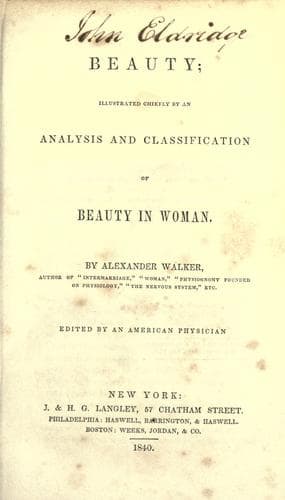
Beauty: Illustrated Chiefly by an Analysis and Classification of Beauty in WomanWalker, Alexander
Philosophy
Beauty: Illustrated Chiefly by an Analysis and Classification of Beauty in Woman
Walker, Alexander
Beauty, Personal; Women
The muscles of the face express all the shades of emotion and passion, not
because such expression is the primary, or the proper object of their
motion, but because their various motions adapt the organs to the farther
purposes required of them in consequence of preceding impressions; and
these motions become expressive to us only because we are thus enabled to
infer the feeling and purpose of the person in whom they occur. This is a
fundamental principle of physiognomy; and its not being understood has led
to many of our errors in that science.
In woman, the countenance is more rounded, as well as more abundantly
furnished with that cellular and, fatty tissue which fills all the chasms,
effaces, all the angles, and unites all the parts by the gentlest
transitions. At the same time, the muscles are feebler, more mobile,
resigned for a shorter time to the same contraction, and as inconstant as
the emotions and passions which their rapid play expresses.
The result of all this is, that the muscles do not profoundly modify the
face, which consequently has not so much of permanent character as that of
a man, and which permits us more difficultly to discover, through the
rounded, short, and shifting parts, the nature of her various feelings.
As, however, the abundance of the cellular tissue diminishes with age, and
as the sentiments become at the same time less ephemeral, the
physiognomical character and expression of woman become more decided.
As to COLOR of the face, it may be observed that the forehead, the
temples, the eyelids, the nose, the upper part of the superior lip, and
the lower part of the inferior lip, ought in woman to be of a beautiful
and rather opaque white. The approach to the cheeks and the middle of the
chin ought to have a slight teint of rose-color, and the middle of the
cheeks ought to be altogether rosy, but of a delicate hue.--Cheeks of an
animated white are preferable to those of a red color, although less
beautiful than those of rosy hue.
With regard to the HAIR, it may be observed, that sometimes, rising from
its bulbs, it turns in irregular rings, and, by displaying a forehead
rather large, confers a certain sanguine, as well as open air upon the
physiognomy. This, however, is most frequently seen in men, and chiefly in
men of exuberant vitality, rather than intellectuality: it indeed depends
entirely on the former.
In other men, and almost always in women, the hair generally divides in a
line extending from the crown to the forehead, and falls over the temples.
The line thus formed, uniting with the median line, of the face in
general, and that of the nose in particular, gives to the whole of the
features a peculiar symmetry and beauty.
Public-domain text, read in full here on John Shaqi.
Reviews
Reviews
No reviews yet
Be the first to share your thoughts on this work.
Elsewhere in the archive
Join the Discussion
Join the discussion
Sign in to leave a comment or review.
Sign InorCreate an account