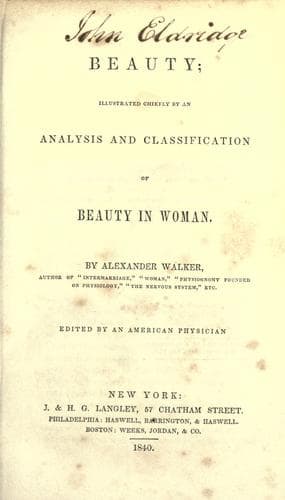
Beauty: Illustrated Chiefly by an Analysis and Classification of Beauty in WomanWalker, Alexander
Philosophy
Beauty: Illustrated Chiefly by an Analysis and Classification of Beauty in Woman
Walker, Alexander
Beauty, Personal; Women
In persons of this temperament, the skin is of a yellowish brown, the hair
black, the muscles marked, the form harshly expressed. "Bold in the
conception of a project," says Richerand, "constant and indefatigable in
its execution, it is among men of this temperament, that we find those
who, in different ages, have governed the destinies of the world: full of
courage, boldness, and activity, they have signalized themselves by great
virtues or great crimes, and have been the terror or admiration of the
universe. Such were Alexander, Julius Cesar, Brutus, Mahomet, Charles
XII., the Czar Peter, Cromwell, Sixtus V., Cardinal Richelieu [and, he
should have added, Bonaparte].... To attain to results of such importance,
the profoundest dissimulation and the most obstinate constancy are equally
necessary; and these are the most eminent qualities of the bilious."
A still more compound temperament is the _melancholic_, in which disease
is added to the bilious temperament, a derangement of the functions of the
nervous system, and the diseased obstruction of some one of the organs of
the abdomen, so that the nutritive functions are feebly or irregularly
performed, the bowels sluggish, the pulse hard and contracted, the
excretions difficult, the imagination gloomy, the disposition suspicious.
In persons of this temperament, the skin is of a still deeper hue, and the
look uneasy and gloomy. Rousseau and Tiberius are excellent examples of
this temperament, as associated with genius and virtue in one, and with
truly royal vice in the other. In women, this temperament is rarely so
intense as in men.
Of the TRANSITIONS of beauty, I have now to observe, that, though one
species of beauty always characterizes the same individual during every
stage of life, yet it is remarkable, that the young woman (whatever
species of beauty predominates) has always a tendency to beauty of the
locomotive system;--that the middle-aged woman has always a tendency to
beauty of the nutritive system;--and that the woman of advanced age has
always a tendency to beauty of the thinking system.
Some women would seem, in the progress of life, to pass through all these
systems (and the more perfect the whole organization, the more will this
seem to be the case); but the accurate observer will always see the
predominance of the same system.
CHAPTER XVII.
PROPORTION, CHARACTER, EXPRESSION, ETC.
Winckelmann says: "I cannot imagine beauty without the PROPORTION which is
always its foundation.--The drawing of the naked figure is founded upon
the idea and the knowledge of beauty; and this idea consists partly in
measures and relations, and partly in forms, the beauty of which was, as
Cicero observes, the object of the first Grecian artists: the latter
determine the figure; the former fix the proportions."
Public-domain text, read in full here on John Shaqi.
Reviews
Reviews
No reviews yet
Be the first to share your thoughts on this work.
Elsewhere in the archive
Join the Discussion
Join the discussion
Sign in to leave a comment or review.
Sign InorCreate an account