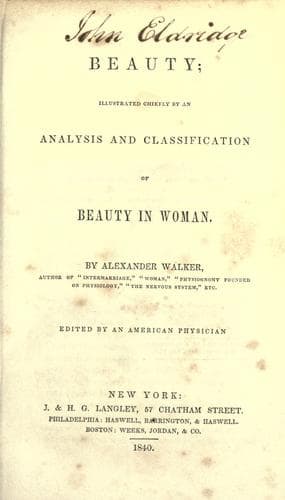
Beauty: Illustrated Chiefly by an Analysis and Classification of Beauty in WomanWalker, Alexander
Philosophy
Beauty: Illustrated Chiefly by an Analysis and Classification of Beauty in Woman
Walker, Alexander
Beauty, Personal; Women
The great variety of proportions presented by the human body causes much
difficulty in determining with precision what are the best. The difficulty
becomes quite insurmountable if we attempt to assign precise dimensions to
the details of configuration or to minute parts.
Many circumstances are opposed to the exactness of these measures. Even in
the same person, one part is rarely in all respects similar to the
corresponding part; we are taller in the morning than in the evening; and
the proportions change at different periods of life. In different
individuals, the differences are still more evident. Moreover, habits,
professions, trades, all unite to oppose regularity in the proportions.
It has farther been observed that, in the conformation of woman, both as
regards the whole and as regards the various parts, nature still more
rarely approaches determinate proportions than in man.
It is remarked by Hogarth, whose views I now abridge, that in society we
every day hear women pronounce perfectly correct opinions as to the
proportions of the neck, the bosom, the hands, and the arms of other
women, whom they have an interest in observing with severity. It is
evident that, for such an examination, they ought to be capable of
seizing, with great precision, the relation of length and thickness, and
of following the slight sinuosities, the swellings, the depressions,
almost insensible and continually varying, at the surface of the parts
observed. If so, it is certainly in the power of a man of science, with as
observing an eye, to go still farther, and conceive many other necessary
circumstances concerning proportion.
But he says: "Though much of this matter may be easily understood by
common observation, assisted by science, still I fear it will be difficult
to raise a very clear idea of what constitutes or composes the utmost
beauty of proportion.... We shall soon find that it is chiefly to be
effected by means of the nice sensation we naturally have of what certain
quantities or dimensions of parts are fittest to produce the utmost
strength for moving or supporting great weights, and of what are most fit
for the utmost light agility, as also for every degree, between these two
extremes."
After some illustrations of this, which naturally leave the method very
vague, he adds: "I am apprehensive that this part of my scheme, for
explaining exact proportion, may not be thought so sufficiently
determinate as could be wished." So that Hogarth's method as to
proportions, both general and particular, reduces itself to the employment
of the eye and the nice sensation we have of quantities or dimensions.
But the Greek artists had not only done what Hogarth thus vaguely speaks
of, but advanced much farther; and indeed all that has been done on this
important subject belongs rather to the history of art than that of
nature.
Public-domain text, read in full here on John Shaqi.
Reviews
Reviews
No reviews yet
Be the first to share your thoughts on this work.
Elsewhere in the archive
Join the Discussion
Join the discussion
Sign in to leave a comment or review.
Sign InorCreate an account