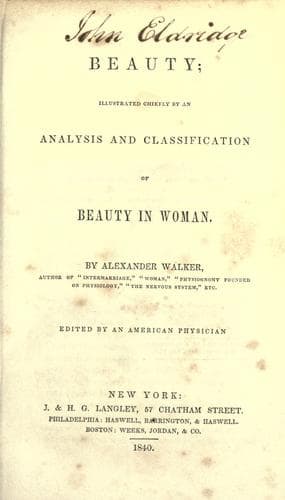
Beauty: Illustrated Chiefly by an Analysis and Classification of Beauty in WomanWalker, Alexander
Philosophy
Beauty: Illustrated Chiefly by an Analysis and Classification of Beauty in Woman
Walker, Alexander
Beauty, Personal; Women
In this, Flaxman agrees, when he says: "It must not be supposed that those
simple geometrical forms of body and limbs, in the divinities and heroes
of antiquity, depended upon accidental choice, or blind and ignorant
arbitration. They are, on the contrary, a consequence of the strict and
extensive examination of nature, of rational inquiry into its most perfect
organization and physical well-being, expressed in outward appearance."
"That the Greeks," says Bossi, "wrote much on this subject [their doctrine
respecting symmetry] we have ample evidence in Pliny, Vitruvius himself,
Philostratus the younger, and others.
"Polycletus did not confine himself to giving a commentary upon this
fundamental point, but, in illustration of his treatise, according to
Galen, made an admirable statue that confirmed the precepts laid down in
the work; and 'The Rule of Polycletus,' the name given to this statue,
became so famous for its beauty, that it passed into a proverb to express
a perfect body, as we may find in Lucian.
"But of so many writings, which ought at least to equal the works that
remain to us, and probably were superior, inasmuch as it is easier to lay
down precepts than to put them in execution--of so many treatises, I say,
not a fragment remains [except the few lines of Vitruvius], nor is there,
now, any hope that a vestige will be found, unless something may remain
for posterity among the papyri of Herculaneum."
Now, to approach to the ancients in excellence is quite impossible, until
some one shall explain the great principles on which they acted. Assuredly
they are, in some of the most important respects, unknown at present.
Servile imitation will never answer the purpose; and to learn as the
ancients did, and reach perfection, perhaps, in as many ages, is not very
rational, when we can avail ourselves of their practice to discover their
principles. I will, in this chapter, endeavor to point out some of these
principles in the practice of art, as I have already done in the general
theory of beauty.
"It is probable," says Winckelmann, "that the Grecian artists, in
imitation of the Egyptians, had fixed, by well-determined rules, not only
the largest, but even the very smallest proportions, and the measure of
the length proper to every age and to every kind of contour; and probably
all these rules were learned by young persons, from books that treated of
symmetry."
These rules, we know, were of three kinds--numerical, geometrical, and
harmonic; and we shall see, in the sequel, that the loss of them has been
much deplored. It is not a little curious, however, that the numerical and
geometrical methods are, in some measure, actually practised even at the
present day, and that the harmonic method (the loss of which has caused
the greatest confusion) is easily deducible from anatomical and
physiological principles, as I shall endeavor to show.
Public-domain text, read in full here on John Shaqi.
Reviews
Reviews
No reviews yet
Be the first to share your thoughts on this work.
Elsewhere in the archive
Join the Discussion
Join the discussion
Sign in to leave a comment or review.
Sign InorCreate an account