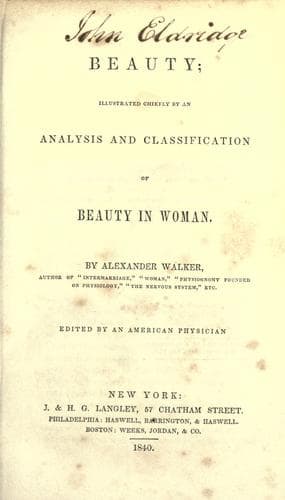
Beauty: Illustrated Chiefly by an Analysis and Classification of Beauty in WomanWalker, Alexander
Philosophy
Beauty: Illustrated Chiefly by an Analysis and Classification of Beauty in Woman
Walker, Alexander
Beauty, Personal; Women
"It is not," says Buffon, "by the comparison of the body of one man with
that of another man, or by measures actually taken in a great number of
subjects, that we can acquire this knowledge [that of proportion]: it is
by the efforts which have been made exactly to copy and imitate nature; it
is to the art of design that we owe all that we know in this respect.
Feeling and taste have done all that mechanics could not do; the rule and
the compass have been quitted in order to profit by the eye; all the
forms, all the outlines, and all the parts of the human body, have been
realized in marble; and we have known nature better by the representation
than by nature itself. It is by great exercise of the art of design and by
an exquisite sentiment, that great statuaries have succeeded in making us
feel the just proportions of the works of nature. The Greeks have formed
such admirable statues, that with one consent they are regarded as the
most exact representation of the most perfect human body. These statues,
which were only copies from man, are become originals, because these
copies were not made from any individual, but from the whole human species
well observed, so well indeed, that no man has been found whose figure is
so well proportioned as these statues: it is then from these models that
the measures of the human body have been taken."
It is now necessary to lay before the reader the principles of the Greeks,
as to the proportions of the human body. Much has been well done on this
subject by Winckelmann, Bossi, and others; but, at the same time, from
want of enlarged anatomical and physiological views, they have overlooked
some fundamental considerations, and have failed to unravel the greatest
difficulties which the subject presents. That the reader may be satisfied
of the accuracy of my representations, I shall lay the statements of these
writers before him in their own words, rendering them only as succinct as
possible.[44]
Of the first epoch of art among the Etruscans and Greeks, Mengs says:
"They preferred the most necessary things to those which were less so; and
therefore they directed their attention first to the muscles, and next to
_proportion_, these constituting the two parts the most useful and
necessary of the human form; and this is, throughout, the character of
their primitive taste. All this we observe in history, and in the divine
and human figures which they have represented.
"In these figures," he farther observes, "we find a proportion, impossible
to be known and practised, without an art which furnishes sure _rules_.
These rules could not be founded otherwise than in proportion, which was
invented and practised by the Greeks."
Public-domain text, read in full here on John Shaqi.
Reviews
Reviews
No reviews yet
Be the first to share your thoughts on this work.
Elsewhere in the archive
Join the Discussion
Join the discussion
Sign in to leave a comment or review.
Sign InorCreate an account