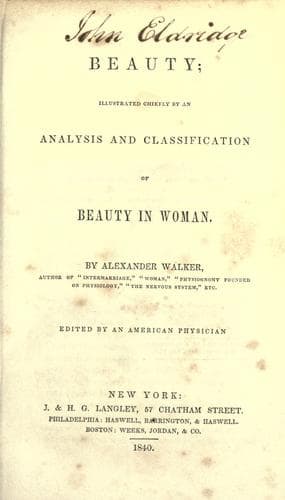
Beauty: Illustrated Chiefly by an Analysis and Classification of Beauty in WomanWalker, Alexander
Philosophy
Beauty: Illustrated Chiefly by an Analysis and Classification of Beauty in Woman
Walker, Alexander
Beauty, Personal; Women
"In the second place, to penetrate completely the natural reason of the
proportions of the human body, would require a knowledge of physics, which
it is not in man's power to obtain. The universal equilibrium of the
numerous constituent parts of the human machine, every one of which
eminently attains the end for which it was destined, without interrupting
the course that every other part takes to its respective end, in which
true proportion seems to consist, is more easily stated than understood.
And even if an artist could arrive at such a knowledge of man as to be
able, so to speak, to compose him, he would have done but little, because
he would have made but one man. By the alteration of only one of the
infinite parts that compose the human frame, the equilibrium and
respective relation of the others are necessarily altered: in short, each
separate individual would be the subject of a totally new study.
"Every human habit, of whatever nature it may be, has an influence over
the human figure, and from the indefinable variety and incalculable
mixture of such habits, there results an infinite variety of figures.
Thus, it is evident that true general proportions cannot be laid down
without violating nature, which it is the object of art to imitate."--If,
by "general proportions," Bossi here means proportions applicable to all
or to a great number, he completely loses sight of the object of the great
man on whose opinions he comments; for he sought _a rule for the harmony
of parts in each distinct individual_!
Again, Bossi abandons, as impossible, the finding of the harmonic rule,
which was the great object of Leonardo.--"From what has been said, we may
finally conclude that large proportions only can be established, and that
placing too much confidence in measures, retards, rather than favors the
arts.
"It was written of Raphael, and is seen, that he had as many proportions
as he made figures. Michael Angelo did the same, and it was his saying,
that he who had not the compasses in his eye, would never be able to
supply the deficiency by artificial means. Vincentio Danti, who treasured
the doctrine of Michael Angelo, asserts in his work, that the proportions
do not fall under any measure of quantity. We have seen the infinite
exceptions of Leonardo, respecting the measurement of man, and his own few
works confirm it. I speak no more of inferior persons among the moderns;
but turning to the ancients, I find that the proportions of every good
statue are different."--And this will be found conformable to the harmonic
rule.
"And speaking generally of works in relievo, what canons can determine the
largeness or smallness of some parts, so as to obtain a greater effect
according to the circumstances of light, distance, material, visual point,
&c.? Certainly none."--This was not to be expected from the rule sought
for.
Public-domain text, read in full here on John Shaqi.
Reviews
Reviews
No reviews yet
Be the first to share your thoughts on this work.
Elsewhere in the archive
Join the Discussion
Join the discussion
Sign in to leave a comment or review.
Sign InorCreate an account