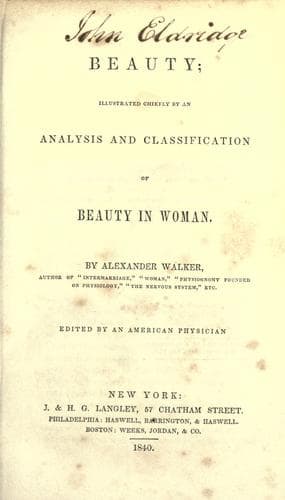
Beauty: Illustrated Chiefly by an Analysis and Classification of Beauty in WomanWalker, Alexander
Philosophy
Beauty: Illustrated Chiefly by an Analysis and Classification of Beauty in Woman
Walker, Alexander
Beauty, Personal; Women
"I shall deem that I have gained some recompense for the toil of wading
through so many tedious works, if it shall induce any faith in the advice
I now give, namely, that 'every student of painting should himself measure
many bodies of acknowledged beauty, compare them with the finest
imitations in painting and sculpture, and from these measures make a canon
for himself, dividing it in the manner best suited to his genius and
memory. If this plan were more generally adopted, art and its productions
would both be gainers.'"--It might do so, among as ingenious a people as
the Greeks, in as many ages as the same method cost them to do it in!
Leonardo da Vinci wanted to abridge the time, instead of beginning again!
Winckelmann as little understands this great man's object, when, after
saying, "As the ancients made ideal beauty their principal study, they
determined its relations and proportions," he adds "from which, however,
they allowed themselves to deviate, when they had a good reason, and
yielded themselves to the guidance of their genius." Why, the whole
purpose of the rule sought for was to regulate every possible deviation,
as will now be seen.
The harmonic method of the Greeks--that measure which Leonardo calls the
"true proportion"--"the proportion of an individual in regard to
himself"--"which should be different in all the individuals of a species,"
but in which "all the parts of any animal should correspond with the
whole," which constitutes "the harmony of the parts of an individual," and
which, as Bossi adds, "varies in every figure, according to the age,
circumstances, and particular character of each"--in short, _this method
for the harmony of parts in each distinct individual--this method
presenting rules, perfectly precise, and yet infinitely variable_, has, in
all its elements, been clearly laid before the reader (though not
enunciated as a rule)--in the relative proportions of the locomotive,
nutritive, and thinking systems, or, generally speaking, of the limbs,
trunk, and head, and in the three species of beauty which are founded on
them.
These, it is evident, present to the philosophic observer, the sole means
of judging of beauty by harmonic rule, the great object of Leonardo da
Vinci's desires and regrets. They present the great features of the Greek
method--if that method conformed to truth and nature, as it undoubtedly
did. This will be rendered still clearer by a single example.
Public-domain text, read in full here on John Shaqi.
Reviews
Reviews
No reviews yet
Be the first to share your thoughts on this work.
Elsewhere in the archive
Join the Discussion
Join the discussion
Sign in to leave a comment or review.
Sign InorCreate an account