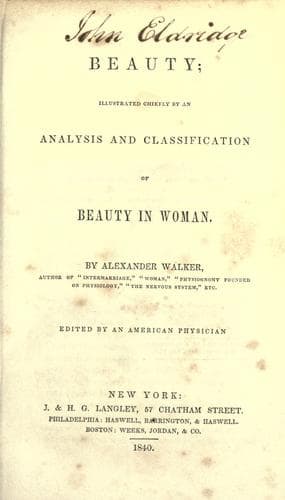
Beauty: Illustrated Chiefly by an Analysis and Classification of Beauty in WomanWalker, Alexander
Philosophy
Beauty: Illustrated Chiefly by an Analysis and Classification of Beauty in Woman
Walker, Alexander
Beauty, Personal; Women
"If different proportions," says Winckelmann, "are sometimes met with in
any figure, as for example, in the beautiful trunk of a naked female
figure in the possession of Signior Cavaceppi at Rome, in which the body
from the navel to the sexual parts is of an uncommon length, it is most
probable that such figures have been copied from nature, that is, from
persons so formed."--Nothing certainly would be better founded in natural
tendency than such idealization.
All the three Greek methods of proportion being now before the reader, I
must briefly notice other circumstances.
In the head in particular, may be observed CHARACTER, or a permanent and
invariable form, which defines its capabilities, and EXPRESSION, or
temporary and variable forms, which indicate its actual functions.
The teachers of anatomy for artists have not, that I know of, clearly
described the causes of these. I may therefore observe, that as character
is permanent and invariable, it depends _fundamentally_ on permanent and
invariable parts--the bones; and as expression is temporary and variable,
it depends on shifting and variable parts--the muscles.
It is well observed by Mengs that, in relation to character, "the
peculiar distinction of the ancients is, that from one part of the face,
we may know the character of the whole." And, of expression, Winckelmann
observes that "the portion which possesses beauty of expression or action,
or beauty of both added to the figure of any person, is like the
resemblance of one who views himself in a fountain; the reflection is not
seen plainly unless the surface of the water be still, limpid, and clear;
quiet and tranquillity are as suitable to beauty as to the sea. Expression
and action being, in art as in nature, the evidence of the active or
passive state of the mind, perfect beauty can never exist in the
countenance unless the mind be calm and free from all agitation, at least
from everything likely to change and disturb the lineaments of which
beauty is composed."
Now the details which, during the period of perfection in art, were so
skilfully employed, were these very means of expression or circumstances
attending and indicating them--minuter forms which are universal, and
without which nature is imperfectly represented--minuter forms of the
highest order, because the means of expressing intellect, emotion, and
passion, if required.
Public-domain text, read in full here on John Shaqi.
Reviews
Reviews
No reviews yet
Be the first to share your thoughts on this work.
Elsewhere in the archive
Join the Discussion
Join the discussion
Sign in to leave a comment or review.
Sign InorCreate an account