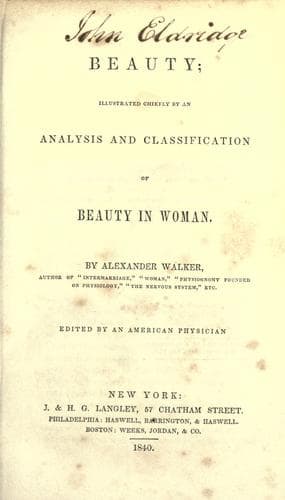
Beauty: Illustrated Chiefly by an Analysis and Classification of Beauty in WomanWalker, Alexander
Philosophy
Beauty: Illustrated Chiefly by an Analysis and Classification of Beauty in Woman
Walker, Alexander
Beauty, Personal; Women
These higher details we find, for instance, in the turn of the inner end
of the eyebrow, or constriction and elevation of the under eyelid, or a
hundred other traits dependant on subjacent muscles. We find them in
slight risings of mere cutaneous parts, when they lie over and are
elevated by the attachment of muscles, as at the inner angles of the
eyes, the corners of the mouth, and elsewhere. We find them in
depressions or furrows, when they are drawn down by contiguous muscles.
These are of higher character, because they belong to expression or its
means; and there is a corresponding want of completeness, of truth, of
nature, without them.
Between these intellectual means, these higher details, and those of a
lower order, accidental details, the great artists of Greece
distinguished. Accidental details have nothing to do with expression or
the means of expression; they depend upon an inferior system, that merely
of life, and constitute all the depositions, excrescences, and growths,
which confuse the vision of the inexperienced, and embarrass that of the
most discriminating, in the examination of higher beauty.
These lower details we find, for instance, in the puffings of adipose
substance which project from the spaces between the muscles of the face,
and from other accidents of the vital system, as wrinkles or folds from
the absence of adipose substance, fulness or emptiness of the vessels,
projecting veins, peculiar conditions of the skin, turbidity of the eyes,
hairs of the head, beard, or skin, &c. These have always characterized
inferior artists and inferior periods of art.
From these observations, it will be seen that such unqualified statements
as the following by Azara, lead only to misconception: "A human face, for
example, is composed of the forehead, brows, eyes, nose, cheeks, mouth,
chin, and beard. These are the great parts; but each of these contains
many other minor parts, which also contain an infinity of others still
less. If the painter will content himself to express well the great parts
which I have taken notice of, he will have a grand style; if he depicts
also the second, his style will be that of mediocrity; and if he pretends
to introduce the last, his style will be insignificant and ridiculous."
CHAPTER XVIII.
THE GREEK IDEAL BEAUTY.
On this important doctrine of art, of which Winckelmann says: "The ideal
is as much more noble than the mechanical as the mind is superior to the
body," I shall follow, so far as I can advantageously, the great writers
on this subject, in order that the reader may have all the confidence in
its recognised portions that authority can bestow, and that he may the
better distinguish them from the new views which are here added.
"There are," says Winckelmann, "two kinds of beauty, individual and ideal:
the former is a combination of the beauties of an individual; the latter,
a selection of beautiful parts from several.
Public-domain text, read in full here on John Shaqi.
Reviews
Reviews
No reviews yet
Be the first to share your thoughts on this work.
Elsewhere in the archive
Join the Discussion
Join the discussion
Sign in to leave a comment or review.
Sign InorCreate an account