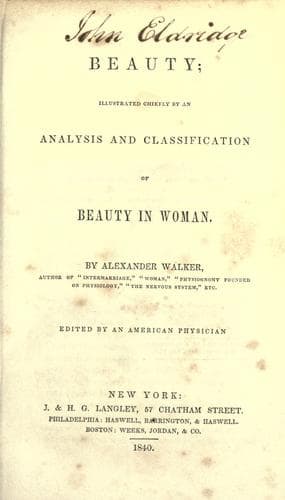
Beauty: Illustrated Chiefly by an Analysis and Classification of Beauty in WomanWalker, Alexander
Philosophy
Beauty: Illustrated Chiefly by an Analysis and Classification of Beauty in Woman
Walker, Alexander
Beauty, Personal; Women
In regard to _the forehead_, then, this afforded their rule for
distinguishing beings of a superior kind. How well they observed the
tendency of nature to increase that angle with the increase of some of the
thinking faculties, we now know. This ideal rule was, therefore, admirably
founded.
Whoever reflects on the nature of this angle will perceive that its
increase tended nowise to raise the forehead, but to throw it forward, and
therefore to lengthen the head. This conforms to the metaphor by which a
_long head_ is used for a _wise head_, and which has not yet given place
to a _broad head_, preferred by the German craniologists, in compliment to
their own organization.
With regard to the height of the forehead, it has already been observed
that it was, among the ancient Greeks, more considerable than its breadth,
as may be seen by the busts of their most illustrious men. Still, neither
the natural nor the ideal forehead much exceeded the space from the
forehead to the bottom of the nose, or that from the nose to the bottom of
the chin.
Winckelmann accordingly says: "The forehead to be beautiful should be low
[meaning, as his expressions elsewhere show, no higher than the other two
spaces just mentioned]; and its lowness was so fixed among the ideas of
beauty by the Grecian artists, that it serves as a mark to distinguish
modern heads from ancient. The reason of this appears founded in the very
rules of proportion, which, as in the whole human body, was among the
ancients tripartite: thus, the face also was divided into three parts; so
that the forehead should be of the same length as the nose, and the
remainder of the face to the chin of the same length likewise. This
proportion was founded on observation, and we may at any time convince
ourselves of it in any individual with a low forehead, by covering with a
finger the hair at the top of the forehead, so as to render it so much
higher, and we shall then see a want of harmony of proportion and how
detrimental a high forehead is to beauty."
Public-domain text, read in full here on John Shaqi.
Reviews
Reviews
No reviews yet
Be the first to share your thoughts on this work.
Elsewhere in the archive
Join the Discussion
Join the discussion
Sign in to leave a comment or review.
Sign InorCreate an account