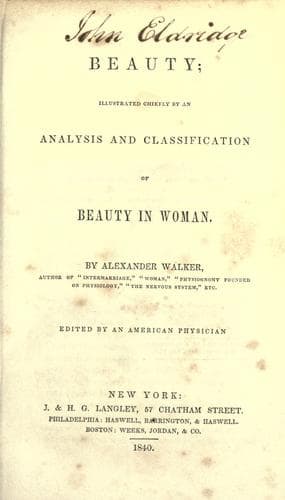
Beauty: Illustrated Chiefly by an Analysis and Classification of Beauty in WomanWalker, Alexander
Philosophy
Beauty: Illustrated Chiefly by an Analysis and Classification of Beauty in Woman
Walker, Alexander
Beauty, Personal; Women
But the grossest errors on this subject have been committed by Alison, who
says: "Artists, in every age, have taken pains to ascertain the most exact
measurement of the human form, and of all its parts.... If the beauty of
form consisted in any original proportion, the productions of the fine
arts would everywhere have testified it; and, in the works of the statuary
and the painter, we should have found only this sole and sacred system of
proportion. The fact however is, as every one knows, that, in such
productions, no such rule is observed; that there is no one proportion of
parts which belongs to the most beautiful productions of these arts; that
the proportions of the Apollo, for instance, are different from those of
the Hercules, the Antinous, the Gladiator, &c.; and that there are not,
in the whole catalogue of ancient statues, two, perhaps, of which the
proportions are actually the same."
Now, I believe, we may say that this original or most perfect proportion
is presented in the Apollo, which is not, as generally supposed, an
example of _peculiar_, but of _universal_ beauty--the locomotive system
presenting as much strength as is compatible with agility, and as much
agility as is compatible with strength, and any other modification of
either ensuring diminution of power; while the vital and mental systems
are equally perfect. Wherever this model is deviated from by the ancient
artists it is _peculiar_ beauty, I believe, that is represented.
He farther says: "They have imagined also various standards of this
measurement; and many disputes have arisen, whether the length of the
head, of the foot, or of the nose, was to be considered as this central
and sacred standard. Of such questions and such disputes, it is not
possible to speak with seriousness, when they occur in the present times."
So also Burke says: "It must be likewise shown, that these parts stand in
such a relation to each other, that the comparison between them may be
easily made, and that the affection of the mind may naturally result from
it."
Now, no man in his senses ever cared which of these measures was adopted,
except as a matter of convenience, or ever imagined that peculiar virtue
resided in any of them.
The following are some of the principal rules which either by intuition
or with due definition, resulted from and guided the practice of the
ancient Greeks.
First, in regard to the THINKING SYSTEM, when the ancient artists, either
from taste or from principle, gave greater opening to the facial angle
than eighty degrees, they believed that an increase of intelligence
corresponded to that conformation. By increasing the angle beyond
eighty-five degrees, they impressed upon their figures the grandest
character, as we see in the heads of the Apollo, the Venus, and others
whose facial angle extends to or exceeds ninety degrees.
Public-domain text, read in full here on John Shaqi.
Reviews
Reviews
No reviews yet
Be the first to share your thoughts on this work.
Elsewhere in the archive
Join the Discussion
Join the discussion
Sign in to leave a comment or review.
Sign InorCreate an account