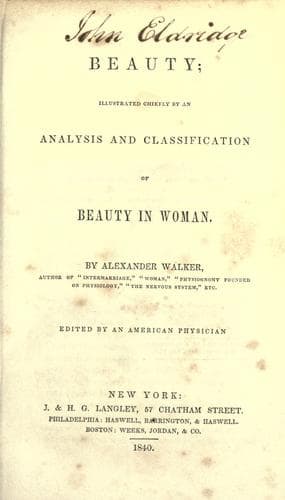
Beauty: Illustrated Chiefly by an Analysis and Classification of Beauty in WomanWalker, Alexander
Philosophy
Beauty: Illustrated Chiefly by an Analysis and Classification of Beauty in Woman
Walker, Alexander
Beauty, Personal; Women
A vague feeling of the curious fact I have here explained, Alison, as a
man of taste, had, when he said: "Apply, however, this beautiful form, to
the countenance of the warrior, the bandit, the martyr, &c., or to any
countenance which is meant to express deep or powerful _passion_, and the
most vulgar spectator would be sensible of dissatisfaction, if not
disgust."
In endeavoring to assign a reason for the configuration which I have just
explained, Winckelmann, in ascribing it to the mere production of effect,
is driven into a ridiculous inconsistency. He thinks that for large
statues seen at a distance, it was necessary, and so came to be used for
small medals seen near, for which it was not necessary.
"In the heads of statues, and particularly in ideal heads, the eyes are
deeper set: the bulb remains more deep than is usual in nature, in which
sunken eyes render the countenance austere and cunning instead of calm and
joyful. In this respect, art has departed with reason from nature; for, in
figures placed to be seen at a distance, if the bulb of the eye were level
with the edge of the orbit, there would be no effect produced of light and
shade; and the eye itself, placed under the eyebrows which do not project,
would be dull and inexpressive. This maxim, adopted for large statues,
became in time universal; so that it may be observed even on medals, not
only in ideal heads but in portraits." And elsewhere he says: "Art
subsequently established it as a rule to give this form to the eyes even
in small figures, as may be seen in the heads on coins."
Thus Winckelmann's reason avowedly explains only the half of that to which
it is applied, and in reality explains nothing, because it leaves a gross
inconsistency, of which Greek genius was incapable.
Of the general outline thus formed of the face, Winckelmann more truly
says: "In the formation of the face, the Greek profile is the principal
characteristic of sublime beauty. This profile is produced by the straight
line, or the line but very slightly indented, which the forehead and nose
form in youthful faces, especially female ones. Nature seems less
disposed to accord this form to the face in cold than in mild and
temperate climes; but wherever this profile is found, it is always
beautiful. The straight full line expresses a kind of greatness, and,
gently curved, it presents the idea of agreeable delicacy. That in these
profiles exists one cause of beauty is proved by the character of the
opposite line; for the greater the inflection of the nose, the less
beautiful is the face; and if, when seen sidewise, it presents a bad
profile, it is useless to look for beauty in any other view."
Public-domain text, read in full here on John Shaqi.
Reviews
Reviews
No reviews yet
Be the first to share your thoughts on this work.
Elsewhere in the archive
Join the Discussion
Join the discussion
Sign in to leave a comment or review.
Sign InorCreate an account