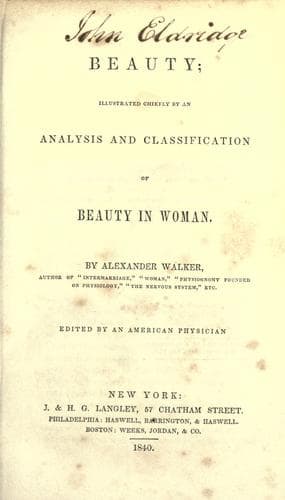
Beauty: Illustrated Chiefly by an Analysis and Classification of Beauty in WomanWalker, Alexander
Philosophy
Beauty: Illustrated Chiefly by an Analysis and Classification of Beauty in Woman
Walker, Alexander
Beauty, Personal; Women
A _third rule_ of the Greek artists, in heads of the highest character, is
greatly illustrated by the new views just stated. If, in these, they
desired to render ideas and intellect more dominant than emotions of
pleasure or pain, and emotions more dominant than passion, it becomes
evident why they equally sought to avoid the convulsions of impassioned
expression.
A very beautiful object of this, is mistaken by Winckelmann. I quote his
words:--
"Taken in either sense [of action or of passion], expression changes the
features of the face, and the disposition of the body, and, consequently,
the forms which constitute beauty; and the greater the change, the greater
the loss of beauty. Therefore, the state of tranquillity and repose was
considered as a fundamental point in the art. Tranquillity is the state
proper to beauty.
"The handsomest men are generally the most mild and the best disposed.
"Besides, tranquillity and repose, both in men and animals, is the state
which allows us best to examine and represent their nature and qualities;
as we can see the bottom of the sea or rivers only when the waves are
tranquil and the stream runs smoothly.
"Therefore, the Grecian artists, wishing to depict, in their
representations of their deities, the perfection of human beauty, strove
to produce, in their countenances and actions, a certain placidity without
the slightest change or perturbation, which, according to their
philosophy, was at variance with the nature and character of the gods. The
figures produced in this state of repose, expressed a perfect equilibrium
of feeling.
"But, as complete tranquillity and repose cannot exist in figures in
action, and even the gods are represented in human form, and subject to
human affections, we must not always expect to find in them the most
sublime idea of beauty. This is then compensated for by expression. The
ancient artists, however, never lost sight of it: it was always their
principal object, to which expression was in some sort made subservient.
"Beauty without expression would be insignificant, and expression without
beauty would be unpleasing; but, from their influence over each other,
from combining together their apparently discordant qualities, results an
eloquent, persuasive, and interesting beauty."
Public-domain text, read in full here on John Shaqi.
Reviews
Reviews
No reviews yet
Be the first to share your thoughts on this work.
Elsewhere in the archive
Join the Discussion
Join the discussion
Sign in to leave a comment or review.
Sign InorCreate an account