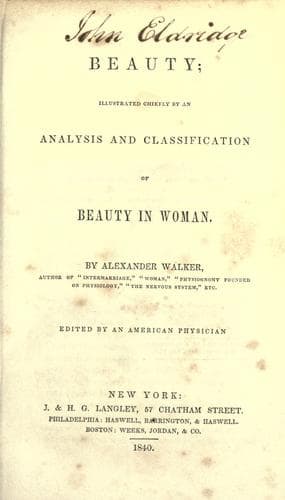
Beauty: Illustrated Chiefly by an Analysis and Classification of Beauty in WomanWalker, Alexander
Philosophy
Beauty: Illustrated Chiefly by an Analysis and Classification of Beauty in Woman
Walker, Alexander
Beauty, Personal; Women
"We have examples of this in two of the most beautiful works of antiquity,
one of which is the image of the fear of certain death, the other of
suffering exceeding anguish.
"Niobe and her daughters, against whom Diana shot her fatal arrows, are
represented as seized with terror and horror, in that state of
indescribable anguish, when the sight of instant and inevitable death
deprives the mind of the power of thought. Of this state of stupor and
insensibility, the fable gives us an idea in the metamorphosis of Niobe
into a stone; and hence Æschylus introduces her in his tragedy as stunned
and speechless. In such a moment, when all thought and feeling ceases, in
a state bordering upon insensibility, the appearance is not altered nor
any feature of the face disturbed, and the mighty artist could here depict
the most sublime beauty, and has indeed done so. Niobe and her daughters
are, and ever will be, the most perfect models of beauty.
"Laocoon is the image of the most acute grief, that puts the nerves, the
muscles, and the veins, in action. His blood is in a state of extreme
agitation from the venomous bite of the serpents; every part of his body
evinces pain and suffering; and the artist has put in motion, so to speak,
all the springs of nature, and thus made known the extent of his art and
the depth of his knowledge. In the representation, however, of this
excessive torment, we can still recognise the conduct of a brave man
struggling against his misfortunes, stifling the emotions of his anguish,
and striving to repress them."
"The ancient artists have preserved this air of composure even in their
dancing figures, except the Bacchanals; and thus an opinion obtained that
the action of their figures should be modelled on the manners adopted in
their ancient dances, and therefore, in their later dances, the ancient
figures served as a model to the performers to prevent their overstepping
the bounds of a modest deportment:
Molli diducunt candida gestu
Brachia. _Propert._
"No immoderate or violent passions are ever found expressed in the public
works of the ancients.
"The knowledge of the ancients cannot be better known than by comparing
their performances with the majority of those of the moderns, in which a
little is expressed by much, instead of much by a little. This is what the
Greeks call [Greek: parenthyrsos]; a word that aptly expresses the defect
produced by too much expression in modern artists. Their figures resemble
in action the comedians of the ancient theatre, who, to render themselves
visible even to the most distant portion of the audience, were compelled
to exceed the limits of nature and truth; and the faces of modern figures
are like the ancient masks, which for the same reason, the increase of
expression, became hideous.
Public-domain text, read in full here on John Shaqi.
Reviews
Reviews
No reviews yet
Be the first to share your thoughts on this work.
Elsewhere in the archive
Join the Discussion
Join the discussion
Sign in to leave a comment or review.
Sign InorCreate an account