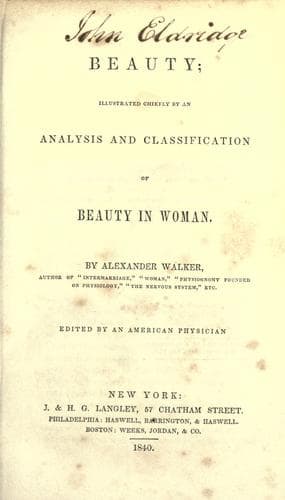
Beauty: Illustrated Chiefly by an Analysis and Classification of Beauty in WomanWalker, Alexander
Philosophy
Beauty: Illustrated Chiefly by an Analysis and Classification of Beauty in Woman
Walker, Alexander
Beauty, Personal; Women
"This excess of expression is taught in a book which goes into the hands
of all young artists, 'A Treatise on the Passions,' by Carlo Le Brun, and
in the annexed drawings, not only is the highest degree of passion
expressed on the face, but in some even to madness."
Hence, we may say with Azara, that "the Greeks possessed that art in such
perfection, that in their statues one scarcely discovers that they had
thought of expression, and nevertheless each says that which it ought to
say. They are in a repose which shows all the beauty without any
alteration; and a soft and sweet motion, of the mouth, the eyes, or the
mere action, expresses the effect, enchanting at once the mind and the
senses."
In the inferior beings, however, when passion is expressed, the features
are varied by the Greek artists as they are in nature.
Such are the great ideal rules with regard to the head and the functions
of thought.
With regard to the body and the NUTRITIVE SYSTEM, the Greeks similarly
idealized. "Seeking for images of worship, consequently of a nature
superior to our own, so that they might awaken in the mind veneration and
love, they thought that the representations most worthy of the Divinity,
and most likely to attract the attention of man, would be those expressing
the continuance of the gods in eternal youth and in the prime of life.
"To the idea derived from the poets, of the eternal youth of the deities,
whether male or female, was added another by which they supposed the
female divinities should have all the appearance of virgins.
"The form of the breast in the figures of the divinities, is like that of
a virgin, which, to be beautiful, must possess a moderate fulness. This
was particularly shown in the breasts, which the artists represented
without nipples, like those of young girls, whose cincture, in the poet's
phrase, Lucina has not yet undone.
On their treatment of the limbs and LOCOMOTIVE SYSTEM, Hogarth throws
light; and, as I am not aware that he was anticipated in this respect, I
quote him:--
"May be," he says, "I cannot throw a stronger light on what has been
hitherto said of proportion, than by animadverting on a remarkable beauty
in the Apollo Belvidere, which hath given it the preference even to the
Antinous: I mean a superaddition of greatness, to at least as much beauty
and grace as is found in the latter.
Public-domain text, read in full here on John Shaqi.
Reviews
Reviews
No reviews yet
Be the first to share your thoughts on this work.
Elsewhere in the archive
Join the Discussion
Join the discussion
Sign in to leave a comment or review.
Sign InorCreate an account