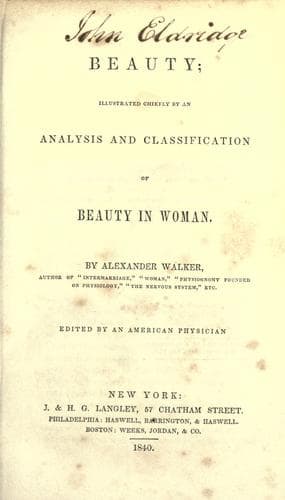
Beauty: Illustrated Chiefly by an Analysis and Classification of Beauty in WomanWalker, Alexander
Philosophy
Beauty: Illustrated Chiefly by an Analysis and Classification of Beauty in Woman
Walker, Alexander
Beauty, Personal; Women
"To the principle I have laid down," says Reynolds, "that the idea of
beauty in each species of being is an invariable one, it may be objected,
that in every particular species there are various central forms which are
separate and distinct from each other, and yet are undeniably beautiful;
that in the human figure, for instance, the beauty of Hercules is one, of
the Gladiator another, of the Apollo another [again the same error]; which
makes so many different ideas of beauty.... It is true, indeed, that these
figures are each perfect in their kind, though of different character and
proportions; but still none of them is the representation of an
individual, but of a class. And as there is one general form, which, as I
have said, belongs to the human kind at large, so in each of these classes
there is one common idea and central form, which is the abstract of the
various individual forms belonging to that class. Thus, though the forms
of childhood and age differ exceedingly, there is a common form in
childhood, and a common form in age, which is the more perfect, as it is
more remote from all peculiarities. But I must add farther, that though
the most perfect forms of each of the general divisions of the human
figure are ideal, and superior to any individual form of that class, yet
the highest perfection of the human figure is not to be found in any one
of them. It is not in the Hercules, nor in the Gladiator, nor in the
Apollo, but in that form which is taken from all, and which partakes
equally of the activity of the Gladiator, of the delicacy of the Apollo,
and of the muscular strength of the Hercules. For perfect beauty in any
species must combine all the characters which are beautiful in that
species. It cannot consist in any one to the exclusion of the rest: no
one, therefore, must be predominant, that no one may be deficient."
"A high degree of particular character," says Barry, "cannot be
superinduced upon pure or simple beauty without altering its constituent
parts; this is peculiar to grace only; for particular characters consist,
as has been observed before, in those deviations from the general standard
for the better purpose of effecting utility and power, and become so many
species of a higher order; where nature is elevated into grandeur,
majesty, and sublimity."
There is AN IDEAL IN ATTITUDE as well as in the form of the head and body.
This ideal is exactly opposed to the academical rule mentioned by
Dufresnoy, Reynolds, and others, namely, that the right leg and left arm,
or the left leg and right arm, should be advanced or withdrawn together.
These are the mere attitudes of progression, not those of expression; and
the academical rule is only an academical blunder. To anything but
walking--to the free and unembarrassed expressions of the body, it is,
indeed, quite inapplicable, and could produce only contortion.
Public-domain text, read in full here on John Shaqi.
Reviews
Reviews
No reviews yet
Be the first to share your thoughts on this work.
Elsewhere in the archive
Join the Discussion
Join the discussion
Sign in to leave a comment or review.
Sign InorCreate an account