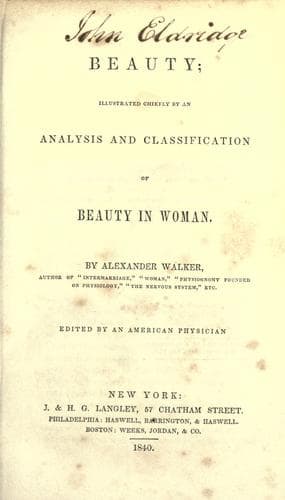
Beauty: Illustrated Chiefly by an Analysis and Classification of Beauty in WomanWalker, Alexander
Philosophy
Beauty: Illustrated Chiefly by an Analysis and Classification of Beauty in Woman
Walker, Alexander
Beauty, Personal; Women
"The same observation," says Alison, "is yet still more obvious with
regard to the difference of sex. In every part of the form, the
proportions which are beautiful in the two sexes are different; and the
application of the proportions of the one to the form of the other, is
everywhere felt as painful and disgusting." So also says Burke: "Let us
rest a moment on this point; and consider how much difference there is
between the measures that prevail in many similar parts of the body, in
the two sexes of this single species only. If you assign any determinate
proportions to the limbs of man, and if you limit human beauty to these
proportions, when you find a woman who differs in the make and measure of
almost every part, you must conclude her not to be beautiful in spite of
the suggestions of your imagination; or in obedience to your imagination
you must renounce your rules; you must lay by the scale and compass, and
look out for some other cause of beauty. For, if beauty be attached to
certain measures which operate from a principle in nature, why should
similar parts with different measures of proportion be found to have
beauty, and this, too, in the very same species?"
To this I might say the beauty of woman is not the highest beauty: it is
beauty of the nutritive more than of the higher thinking system. But there
is another and a better answer: the difference of sex which affects all
the higher animals is a greater difference than that which subsists
between some of their varieties or even of their species; and the same
laws of ideal beauty are as inapplicable to different sexes as to
different species.
"We see, every day, around us," says Alison, "some forms of our species
which affect us with sentiments of beauty. In our own sex, we see the
forms of the legislator, the man of rank, the general, the man of science,
the private soldier, the sailor, the laborer, the beggar, &c. In the other
sex, we see the forms of the matron, the widow, the young woman, the
nurse, the domestic servant, &c.... We expect different proportions of
form from the painter, in his representation of a warrior and a shepherd,
of a senator and of a peasant, of a wrestler and a boatman, of a savage
and of a man of cultivated manners.... We expect, in the same manner, from
the statuary, very different proportions in the forms of Jove and of
Apollo [this should have been excepted], of Hercules and of Antinous, of a
Grace and of Andromache, of a Bacchanal and of Minerva," &c.
That, in all these cases, the beauty is partial, is evident from the
circumstance that what is found in one is wanting in another; and partial
beauty is not perfect beauty. But this last point has been well stated by
Reynolds and Barry.
Public-domain text, read in full here on John Shaqi.
Reviews
Reviews
No reviews yet
Be the first to share your thoughts on this work.
Elsewhere in the archive
Join the Discussion
Join the discussion
Sign in to leave a comment or review.
Sign InorCreate an account