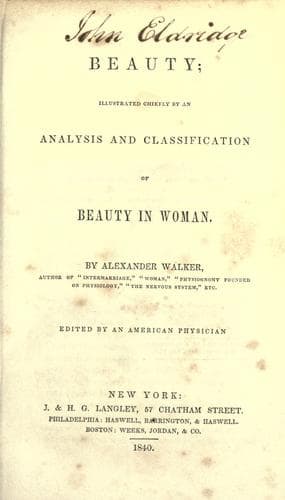
Beauty: Illustrated Chiefly by an Analysis and Classification of Beauty in WomanWalker, Alexander
Philosophy
Beauty: Illustrated Chiefly by an Analysis and Classification of Beauty in Woman
Walker, Alexander
Beauty, Personal; Women
In women of this conformation, moreover, the slightest indisposition or
debility is indicated by a slight vibration of the shoulders, and upper
part of the chest, at every step, in walking.
In considering _the line or direction of the limbs_--if, viewed behind,
the feet, at every step, are thrown out backward, and somewhat laterally,
the knees are certainly much inclined inward.
If, viewed in front, the dress, at every step, is as it were, gathered
toward the front, and then tossed more or less to the opposite side, the
knees are certainly too much inclined.
In considering _the relative size of each portion of the limbs_--if, in
the walk, there be a greater or less approach to the marching pace, the
hip is large; for we naturally employ the joint which is surrounded with
the most powerful muscles, and, in any approach to the march, it is the
hip-joint which is used, and the knee and ankle-joints which remain
proportionally unemployed.
If, in the walk, the tripping pace be used, as in an approach to walking
on tiptoes, the calf is large; for it is only by the power of its muscles
that, under the weight of the whole body, the foot can be extended for
this purpose.
If, in the walk, the foot be raised in a slovenly manner, and the heel be
seen, at each step, to lift the bottom of the dress upward and backward,
neither the hip nor the calf is well developed.
Even with regard to the parts of the figure which are more exposed to
observation by the closer adaptation of dress, much deception occurs. It
is, therefore, necessary to understand the arts employed for this purpose,
at least by skilful women.
A person having a narrow face, wears a bonnet with wide front, exposing
the lower part of the cheeks.--One having a broad face, wears a closer
front; and, if the jaw be wide, it is in appearance diminished, by
bringing the corners of the bonnet sloping to the point of the chin.
A person having a long neck has the neck of the bonnet descending, the
neck of the dress rising, and filling more or less of the intermediate
space. One having a short neck has the whole bonnet short and close in the
perpendicular direction, and the neck of the dress neither high nor wide.
Persons with narrow shoulders have the shoulders or epaulets of the dress
formed on the outer edge of the natural shoulder, very full, and both the
bosom and back of the dress running in oblique folds, from the point of
the shoulder to the middle of the bust.
Persons with waists too large, render them less before by a stomacher, or
something equivalent, and behind by a corresponding form of the dress,
making the top of the dress smooth across the shoulders, and drawing it in
plaits to a narrow point at the bottom of the waist.
Those who have the bosom too small, enlarge it by the oblique folds of the
dress being gathered above, and by other means.
Public-domain text, read in full here on John Shaqi.
Reviews
Reviews
No reviews yet
Be the first to share your thoughts on this work.
Elsewhere in the archive
Join the Discussion
Join the discussion
Sign in to leave a comment or review.
Sign InorCreate an account